


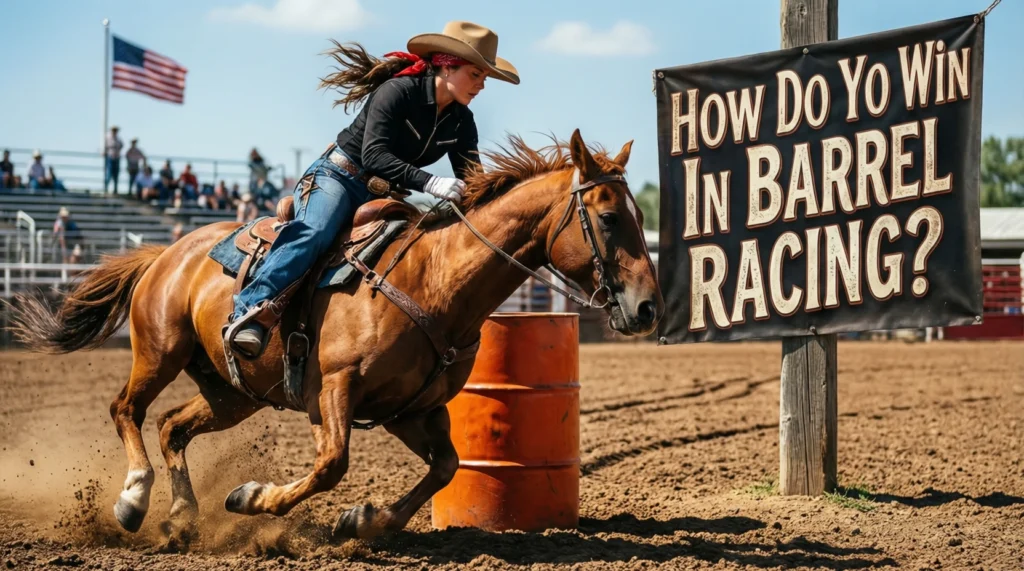
How Do You Win In Barrel Racing? Winning in barrel racing is determined by completing a specific cloverleaf pattern around three barrels in the fastest time without any penalties. With a typical winning run lasting 15-17 seconds at the professional level. Key strategies include maintaining a tight, precise pattern, avoiding penalties, and having a confident, well-trained horse. A five-second penalty is added for each knocked-over barrel.
This video provides an overview of the basics of barrel racing.

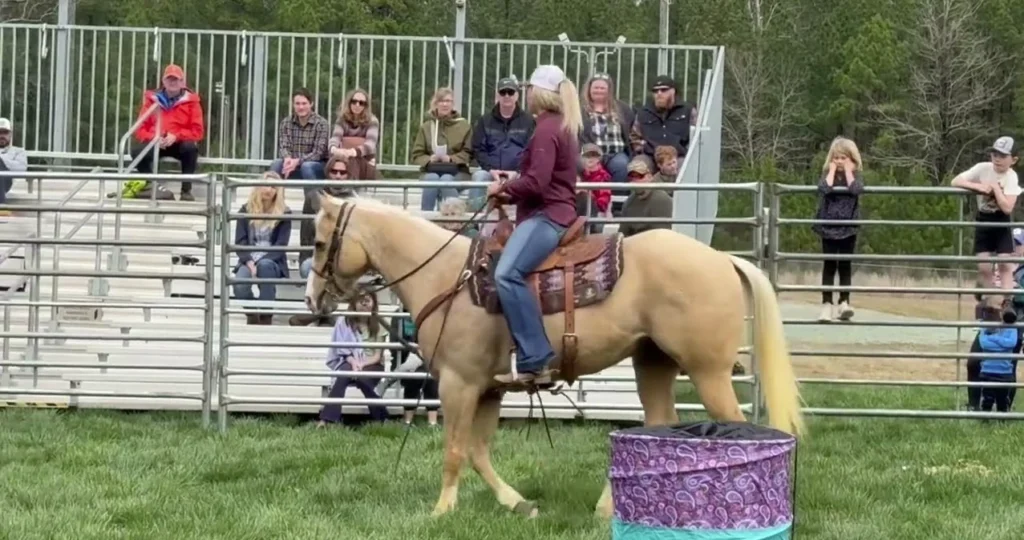
Table of Contents
Key Strategies for Winning:
- Master the Pattern: Perform the cloverleaf pattern accurately, starting with the right or left barrel, completing a 360-degree turn around each, and finishing by crossing the timer line.
- Avoid Penalties: A “no time” (disqualification) occurs if the pattern is broken, while each overturned barrel adds 5 seconds to the total time, often making it impossible to win.
- Tight Turns and Proper Positioning: Use “pocket” creation (space) to allow the horse to turn closely without hitting the barrel. Efficient, tight turns are essential for speed.
- Consistent Training: Practice the pattern at different speeds – walk, trot, and loop – to build confidence and memory.
- Develop Horse Ability: A successful barrel horse must be athletic, balanced, and capable of fast, fast turns and fast, tight turns.
- Mental preparation: Visualize the run, walk down the street, and make sure both rider and horse are confident before entering the arena.
- The Pocket: Riders aim for a “pocket” – a specific approach that widens slightly and narrows – to maximize speed without tipping the barrel.
- Get Rating: This refers to the horse shortening its stride and effectively shifting its weight to its hindquarters before turning towards the axle.
- Efficient Turn: Ideally, a turn consists of three equal steps in a half circle around the barrel.
- Body positioning: Riders sit deep in the saddle (“butt heavy”) to slow the horse down for turns and lean forward to encourage explosive speed between barrels.
Watch this video for tips on how to get a fast turn on the barrel:

Techniques for Speed:
- Approach: Ride confidently and maintain a straight line between the barrels.
- Turn: Sit and relax to signal the horse to bring its hind end under you for a tight, sharp turn.
- Rider’s Role: Keep the horse balanced and use two hands to maintain control when necessary before approaching the barrel.
The Official Pattern
Competitors must navigate a triangular arrangement of barrels in a cloverleaf pattern.
- Route: Riders enter the field by galloping across a starting line to trigger an electronic timer. They can choose to go around the right or left barrel first.
- Right Start: One right-hand turn followed by two left-hand turns.
- Left Start: One left-hand turn followed by two right-hand turns.
- Finish: After going around the third barrel, the rider sprints back to the start/finish line to stop the clock.
Avoiding Penalties
Success often depends on “clean” runs. Even the fastest horse rarely overcomes heavy time deductions for mistakes.
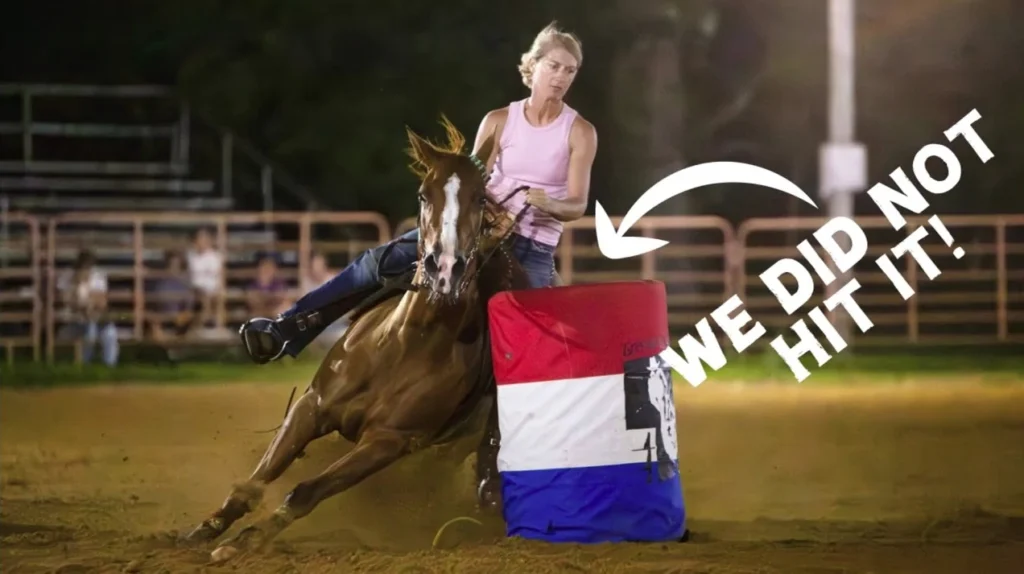
- Knocked Barrel: A 5 second penalty is added to the total time for each barrel knocked. Touching the barrel is allowed as long as it remains upright.
- Broken Pattern: Failure to follow the correct cloverleaf path or crossing the start/finish line before the run is complete results in disqualification (often referred to as a “no time“).
Competitive Divisions (The 4D System)
In many non-professional competitions, winners are determined by a “distributive” system to allow riders of different skill levels to win prize money.
1D (First Division): Fastest time of the event.
2D: Usually 0.5 seconds behind the fastest time.
3D: Usually 1.0 seconds behind the fastest time.
4D: Usually 2.0 seconds behind the fastest time.
Penalties That Cost the Win:
Flawless running is fast, but clean running is essential. Penalties are harsh and designed to prioritize safety and correct execution.
Common Barrel Racing Penalties
| Penalty | Description | Consequence |
|---|---|---|
| Knocked Barrel | A barrel is tipped over. | Adds 5 seconds to the total time |
| Off Pattern | The rider fails to follow the correct cloverleaf sequence or misses a barrel. | Results in a “No Time” (disqualification) |
| Exceeding Time Limit | The run takes longer than 60 seconds after the timer starts. | Results in a “No Time” |
Barrel Racing History
Barrel racing emerged in 1928 as a two-barrel figure eight at Texas rodeos, evolving into a three-barrel cloverleaf by 1935. Today, it’s a WPRA and PRCA staple, with overall NFR winners like 2025’s Julie Plourde clocking 139.67 seconds over 10 rounds.
Rules and Scoring
Riders choose left or right first on a 55-gallon metal barrel in a triangle. Time starts at the line and must be completed within 60 seconds. Fastest clean time wins 5-second penalty per knocked barrel; pattern break or out-of-turn results in “no time” disqualification. Occasional drag footing in the arenas; standard pattern sees local wins in Texas in 16.4-16.5 seconds.
| Penalty Type | Consequence | Impact |
|---|---|---|
| Knock Barrel | +5 seconds | Turns 16.5 win to 21.5 loss |
| Break Pattern | No time (DQ) | Immediate elimination |
| Early Start | Invalid run | Restart required |
Pro Insights and Case Studies
Kassie Mowry won the 2025 NFR by switching horses for Rounds 1 and 6 wins, as well as consistent 2nd/3rd finishes, hitting 72% of payouts. Emily Beasley’s 69% of her performance came from consistent patterns. Experts like Sharon Camarillo advise patient vision and top mentors. Michele McLeod emphasizes homework for three perfect turns, letting momentum follow.
Are you looking for a breakdown compared to previous legendary Rodeo Riders like JB Mauney Injury & Jose Vitor Leme Injury?
I can provide a side-by-side comparison of their career earnings and titles.


JB Mauney Injury
or


Jose Vitor Leme Injury
Frequently Asked Questions: How Do You Win In Barrel Racing?
What’s a standard barrel pattern?
A standard barrel racing pattern, regulated by the WPRA, consists of three 55-gallon drums arranged in a triangle, with 90 feet between barrels 1 and 2, 105 feet between barrels 1 and 3, and 105 feet between 2 and 3. The pattern includes a time of 60 feet from the first barrel and a time of 20 feet from the second barrel.
How fast to win locals in barrel racing?
A time between 14 and 17.5 seconds is typically required to win a local barrel race, although the specific time depends heavily on the size of the field and the competition’s division system.
Can beginners compete safely in barrel racing?
Yes, beginners can safely compete in barrel racing by following safety protocols and progressive training. While the sport involves high speeds and inherent risks, it is widely accessible through divisions designed for novices.
What if I touch a barrel racing?
In barrel racing, the rules for touching a barrel depend on the competition’s governing body, but generally, there is no penalty for simply touching or bumping a barrel as long as it remains upright.
Best horse traits for winning in barrel racing
The best barrel horses have a combination of explosive speed, agility, and a “thinking” mentality, often found in Quarter Horses with strong hindquarters and short loins. Key traits include a, low hocks, and strong shoulders for turning, along with a willingness to learn and the ability to maintain fluid movement over a variety of ground conditions.
Your Path to the Payoff
Winning at barrel racing is a multi-faceted pursuit. It starts with mastering technical principles and patterns. It’s achieved through relentless focus on the fundamentals of turning, building an athletic horse with a reliable mind. It’s sustained by competing in the right competitions for your level and respecting the safety and ethical standards of the community. Ultimately, the fastest times are posted by those who understand that racing is a partnership, a short, explosive testament to thousands of hours of patient, mindful training. Whether your goal is the bright lights of the NFR or the satisfaction of a personal best at the local jackpot, the journey around those three barrels is a relentless pursuit of unity, precision and speed.