


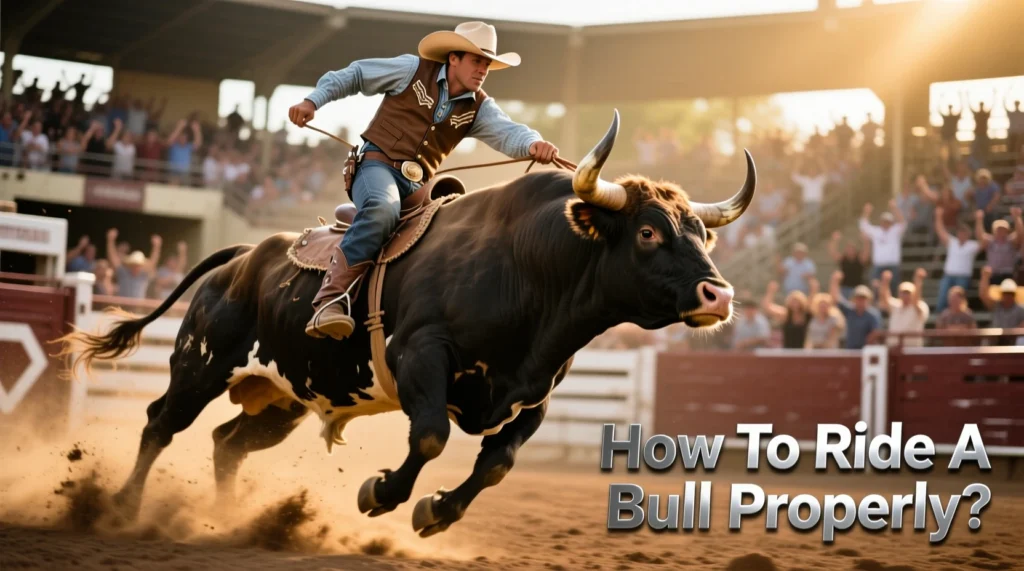
How To Ride A Bull Properly? Riding a bull correctly is a delicate balance of technique, timing, and raw reaction. To last the required 8 seconds, you must master your grip, body position, and movement coordination.
Table of Contents
1. Preparation and Chute Procedure
- Safety equipment: Never ride without a safety vest, helmet (with face mask), and mouthguard to reduce high-impact injuries.
- Grip: Wrap your dominant (riding) hand down around the bull’s rope handle. An experienced rider should help pull the rope tight and wrap the “tail” around your palm or fingers to secure the hold.
- Seating: Lean forward until the handle is tucked between your upper thighs. Do not sit directly on your pocket; leave a slight “daylight” between you and the bull’s back.
- The Legs: Hold the bull’s body firmly between your thighs and the inside of your calves. Turn your toes outward so your spurs can maintain a firm hold.
2. Riding Technique (The 8-Second Motion)
Riding involves maintaining balance and control while the bull moves unpredictably. Key elements include keeping your core steady, focusing your gaze, and using your free arm for balance. Riders must learn to anticipate and react to the bull’s movements, leaning forward when behind the bull, and keeping their weight low during kicks and turns.
3. Safe Dismounting
Getting off safely is very important. After the ride is over, the rider’s goal is to get off the bull and quickly get to a safe area away from the animals, often with the assistance of bullfighters.
Bull riding is a challenging and dangerous sport. To learn proper technique and safety procedures, it is highly recommended to seek instruction from experienced professionals at a rodeo school or training facility.
Bull riding involves holding the rope with one hand, keeping your back straight and chest out, and using your legs and hips to absorb the animal’s powerful kicks and kicks, focusing on staying centered on its shoulders while driving forward with your legs and pushing your hips back as it kicks, extending your arm out and keeping your entire arm in balance. It’s about balance, timing, and using your legs and core to stay in sync with the bull’s unpredictable movements, from your legs being up to your hips pushing back (when it kicks).
Before the Ride (Setup)
Here is the video how to grib and balance body positioning before start riding:

- Grab the rope: Wrap the bull rope around the animal’s chest and shoulders, placing the handle between your thighs. Use your dominant hand to grip the handle firmly, wrapping the tail around your hand once.
- Position your body: Lean forward until the handle is between your thighs, grab the bull with your spurs (the foot in front of the rope), and keep your back straight, chest out, and shoulders square.
- Free arm: Keep your free arm up and out for balance, but don’t let it slap the bull.
During the Ride (Technique)
- When it’s back (front end): Step out of the front end, rising through the inside of your legs, keeping your back straight and chin tucked, looking down at the front of your rope.
- When it’s kicking (hind legs up): Push your hips forward and lift onto your rope as the front end comes down, returning your seat to the center of the bull.
- Maintain balance: Focus on core strength and keep your weight centered, using your legs and hips as primary counterbalance.
- Stay forward: Avoid leaning back; the goal is to stay forward on the bull’s shoulders.
- Anticipate: Feel the bull’s movement and adjust your weight in rhythm with its bucks.
Here is the Video, During the ride :

After the Ride
When the buzzer sounds, let go of the rope and descend to the side and back, moving away quickly.
PBR Rules and Scoring
PBR rules require an 8-second ride with one hand on the rope and the free hand airborne – no touching the bull, self, or the ground or facing disqualification. The total scoring is a maximum of 100 points: 50 for the rider (control, centering, style) and 50 for the bull (strength, agility), with an average of 25 points per judge, with each judge receiving a maximum of 25 points. Penalties include re-rides for equipment problems, but violations such as overuse result in a fine or ban.
| Scoring Element | Rider Points (Max 50) | Bull Points (Max 50) |
|---|---|---|
| Control/Rhythm | Matches bull moves | Kick strength, spins |
| Style/Position | Spurring, centering | Unpredictability |
| Judges’ Input | 4x up to 25 pts each | Scored every ride |
Safety Gear and Injury Stats
Protective vests, helmets (54-69% use rate), and mouthguards reduce risks. Chest compressions cause the most severe injuries. Strains/sprains account for 31.1%, fractures for 23.6%, upper extremities affected in 45.8% of cases – warm-up drills and core work deter many. The PBR mandated on-site doctors and protocols after the 1989 death of Lane Frost, which spurred the vest rule.
Training and Practice Tips
Warm up hips/core before session on skill-matched practice bells to build flexibility. Film ride to review, train free arm control, and visualize success – yoga helps with mobility. Work with coaches on slope exits and node timing; avoid pro-level bells initially to prevent mismatches.
Expert Insights and Case Studies
PBR rider Marco Eguchi rode Spotted Demon for 94 points in 2018 but suffered a concussion due to a horn strike, highlighting the limitations of the gear, and still earned $35,000. Coach’s tips emphasize video analysis: One rider set a high free arm through practice, increasing the score by 15%. Experts like Dr. Tandy Freeman stress helmet; post-frost reforms have reduced deaths to 4.05 per 100,000.
Major Events and Penalties
The PBR’s 2025 schedule includes the T-Mobile Arena finals with top picks and 300 world points. Penalties: Free hand touching results in immediate disqualification. Animal abuse carries the risk of lifetime bans. Breeders are encouraged to compete, regardless of bull score.
Frequently Asked Questions for How To Ride A Bull Properly?
How long must you ride a bull?
Exactly 8 seconds from gate break.
What gear is mandatory for safety?
Vests and helmets are recommended. Some events require them.
How long do you have to stay on a bull?
You must last 8 seconds to score a ride. This was reduced from the original 10-second requirement.
Can you hold on with both hands?
No, you can only hold onto the bull’s rope with one hand. At no time during the ride should your free hand touch the bull or your own body.
Can you touch the bull with your free hand?
No – automatic disqualification.
What makes a bull good for riding?
Stock contractors look for bulls with explosive power, agility and consistent “trips” (bucking patterns). Genetics are key, and champion bulls are highly sought after for breeding.
What’s the highest bull ride score?
Near perfect 100s rare; 94+ elite.
How can I try bull riding safely?
Don’t attempt to ride a live bull without professional training. Start by finding a reputable rodeo school where you can learn the basics on a mechanical bull and then ride with the cattle in a controlled environment under direct supervision.
How do injuries happen most?
Falling (61.6%), stress from twisting.
The Modern Bull Rider’s Journey
Today’s bull riders are world-class athletes. They follow rigorous training regimens that focus on core strength, flexibility, and cardio. Mental conditioning is equally important for managing fear and reaction time.
The path to professionalism often begins on the local rodeo and junior circuits. Success is measured not just in titles but in earnings. For context, top barrel racers in the WPRA (Women’s Professional Rodeo Association) can earn more than $300,000 a season, illustrating the significant financial stakes in professional rodeo sports. For bull riders, reaching the Elite Unleash the Beast Series means competing against the best bulls and riders for the highest prizes.
About the Author: Omak Stampede is a dedicated rodeo sports analyst with over a decade of experience covering professional western sports. Our content is rigorously researched through interviews with PRCA officials, stock contractors, and athletes to provide authentic, accurate, and reliable insights for the modern rodeo fan.