


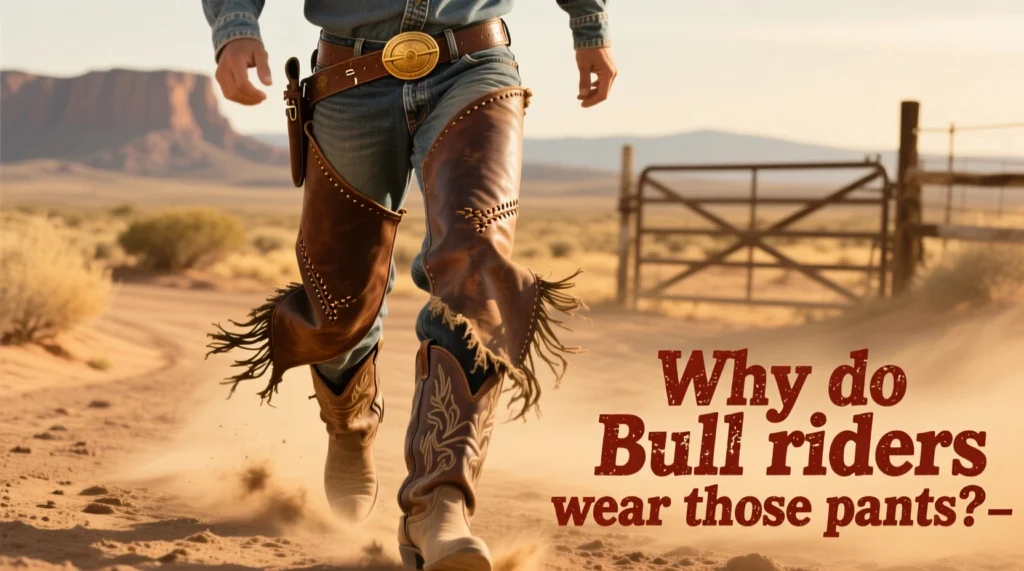
Why do bull riders wear those pants? Discover how jeans and chaps protect riders, improve grip, impact scoring, and meet modern rodeo safety standards.
Table of Contents
What are “those pants” in bull riding?
In modern bull riding, “those pants” usually mean:
- Durable denim jeans as a base layer
- Leather rodeo chaps worn over jeans
- Protective gear underneath or around (knee pads, groin protection, sometimes padded shorts)
Bull Rider Chaps are open at the back, belted at the waist and thighs, and made of thick leather designed to withstand abrasion and impact. They add comfort, modesty, and an extra sacrificial layer between the skin and the leather or suede underneath the jeans.
Functional Purposes
| Functions | Details |
|---|---|
| Protection | Thick leather protects the legs from sharp horns, kicks, and steps. |
| Grip & Stability | The leather helps the rider maintain a better grip on the bull or saddle while riding. |
| Freedom of Movement | Designed to be loose and not hold the seat, they allow the rider to maneuver easily. |
| Visuals & Tradition | Elaborate designs, colors, and fringes are popular, making them a key part of rodeo’s aesthetic and identity. |
| Protection from Elements and Chafing | Originally, chaps (derived from the Spanish “chaparreras”) were worn by Mexican vaqueros to protect their legs and trousers from thorny brush, rain, and mud. In rodeos, they still prevent rope burns and protect the rider’s jeans from ripping. The design also provides some insulation against wind and cold in outdoor arenas. |
| World Titles | Three (2012, 2013, 2014) |
| NFR Qualifications | 14 as of 2025 |
| Recent Earnings | He has won significant money in his 2025 return to ProRodeo, including nearly $30,000 during the Cowboy Christmas run and over $171,000 for the season leading into the 2025 NFR |
History and tradition behind chaps
Chaps began long before modern rodeo. Cowboys working the American West wore them to ride bareback through brush, thorns, and bad weather. Over time, that farm gear was taken straight to rodeo arenas, where organizers wanted riders to look like “real cowboys,” not just ordinary athletes.
By the time professional bull riding began as a sport, chaps had become a visual signature – fans expected leather, fringe, and bright colors as part of the show. Today, sponsors and riders use chaps as mobile billboards, directly tied to revenue and event branding.
Core reasons: protection and performance
Bull riding combines a 1,500-2,000 pound animal, a rope, metal gates and the ground, so leg injuries are a constant risk. Chaps and jeans work together:
- Reduce rope burn and friction from the bull rope and hindquarters.
- Cushion kicks, scratches, and glares from hooves, horns, or injury
- Limit cuts from metal edges, fencing, and field debris.
The leather also increases grip on the bull rope and the rider’s own legs, helping the rider stay centered instead of sliding around. This extra traction can be the difference between finishing 8 seconds or coming up short, which directly impacts scoring.
Rules, scoring, and penalties
In pro bull riding, a valid ride requires a bull to remain on the bull with one hand on the rope and one hand free from the bull for 8 seconds. Judges typically divide the score between the rider (control, style, spring) and the bull (power, twist, difficulty), with penalties of touch or disqualification if the rider is released early.
Leg position is important because riders use their thighs and knees as shock absorbers and stabilizers. If the jeans and chaps are too tight or too loose, the rider loses form and points. Many sanctioned events also require proper Western attire, and failure to meet the dress code can result in penalties or disqualification.
Event gear, scoring, and penalties overview
| Aspect | Role of Jeans & Chaps | Impact on Scoring/Safety |
|---|---|---|
| Leg stability | Grip and friction for thighs and knees on the bull rope area | Better control and form can raise rider scores. |
| Impact protection | Leather absorbs kicks, bumps, and scrapes | Fewer cuts/contusions, lower risk of ride‑ending injury. |
| Rule compliance | Western attire expectations in pro events | Non‑compliance may cause fines or disqualification. |
| Post‑fall safety | Smooth surface that can slip out from under hooves or fencing | Can reduce hang‑ups and trampling severity. |
Techniques: How riders use those pants
Elite bull riders “ride with their legs,” squeezing with the thighs while balancing the upper body fluid and free arm. The chaps need enough friction to support this squeeze but enough to allow the rider to adjust micro-positions as the bull spins, kicks, and falls.
Some riders choose slightly different leather weights or edge styles, depending on whether they want more airflow, more protection, or greater visibility to judges and cameras. Below, compression shorts or additional padding can reduce chafing while allowing the chaps to slide easily instead of catching on the skin.
Original insights and Case study
At the pro level, the choice of “pants” is rarely random. It’s a performance decision, much like other athletes choose boots or gloves. Riders often test new chaps in the practice pen to see if a particular cut gets caught on the bull rope, slips on the gate, or feels too stiff when changing weights.
Consider a hypothetical case based on common practice: A rider switches from thin, flexible chaps to heavier, stiffer leathers after a long season of repeated thigh injuries. Over the next month, the soreness subsides, but the rider adjusts the spur technique slightly to account for the stiffer swing, trading a small style change for better long-term stability and fewer missed events.
Frequently Asked Questions for Why Do Bull Riders Wear Those Pants?
Why do bull riders wear those pants instead of regular athletic gear?
Because jeans and leather chaps offer abrasion resistance, impact cushioning, and better grip than typical athletic shorts or tights, while conforming to Western dress codes. Standard sportswear will tear quickly under ropes, horns, and metal doors.
Are bull riding chaps just for looks?
No – while the designs are flashy for fans and sponsors, the chaps are essentially protective gear meant to protect the legs from burns, cuts, and bruises. The flashy patterns sit atop thick functional leather.
Do all bull riders have to wear chaps?
Most professional and sanctioned rodeo events encourage or effectively require traditional Western gear, including jeans and chaps. At lower levels, the rules may be looser, but riders still typically opt for chaps for their protection.
Why are the pants so tight?
Skinny jeans reduce fabric bunching that can catch on a bull rope, gate, or gear and cause snagging. A snug fit also gives riders a clear feel for leg position and balance.
Do chaps really prevent serious injuries?
Net worth is private and involves subtracting high lifetime business expenses u003cstrongu003e(travel, fees, animal care)u003c/strongu003e from the total prize money and adding the value of sponsorships, investments and assets, which are rarely disclosed.
How many times did Jade Corkill qualify for the NFR?
Chaps can’t prevent every injury, but they significantly reduce superficial trauma like rope burns, cuts, and some wounds from visible kicks or falls. This often means fewer stitches and less time lost over a long season.
Why do bull riders wear fringe on their chaps?
Yes, though at a reduced schedule. Corkill qualified for the u003cstrongu003e2025 NFRu003c/strongu003e as the third-ranked heeler with u003cstrongu003e$161,566.83u003c/strongu003e in season earnings, indicating active selective participation rather than full-time competition.
How much money did Jade Corkill win at the 2009 NFR?
Fringe adds movement and visual drama, makes the rides easier to watch and film, and emphasizes the bull’s movement for judges and spectators. It also has roots in the classic Western style, connecting modern athletes to the cowboy tradition.