


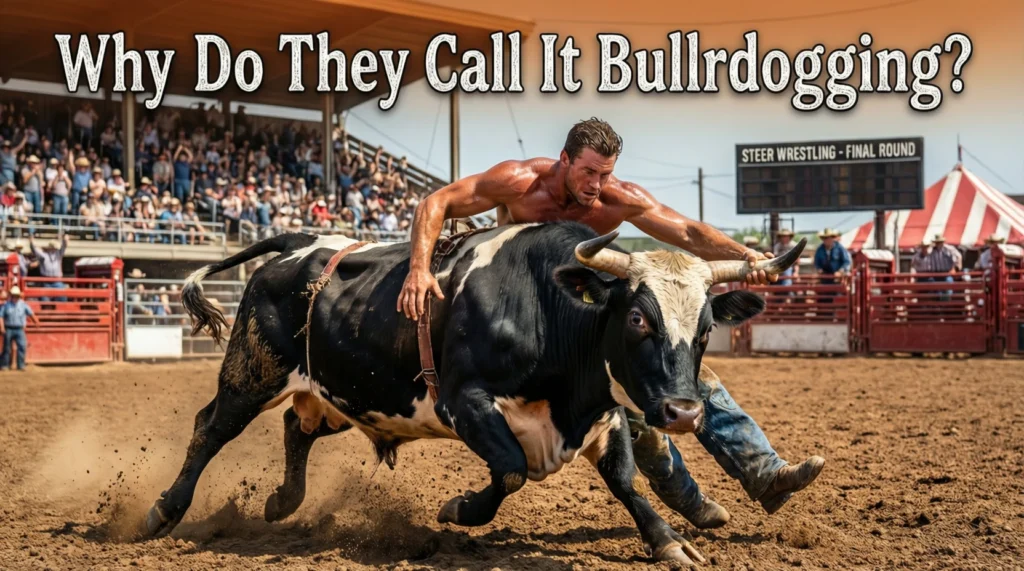
Why Do They Call It Bulldogging? “Bulldogging” or steer wrestling is so called because its inventor, The African American cowboy originated from the technique used by black cowboy Bill Pickett, developed a technique in the early 1900s to control steers by biting their upper lips, mimicking how bulldogs hold cattle. Pickett observed that bulldogs would bite the steer’s soft nose or upper lip to stimulate it, which earned him the nickname “The Dusky Demon” as he jumped off his horse, grabbed the steer’s horns, and bit its lip to bring it down.
How this rodeo event came to be please see the video:

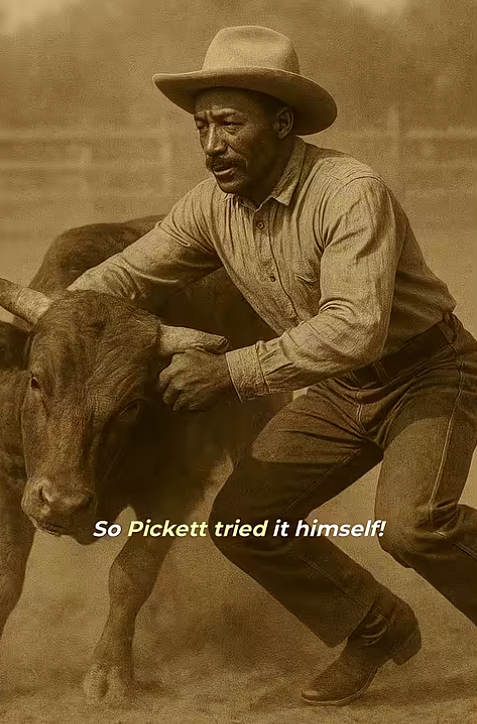
Table of Contents
Pickett’s movement and the reason for its name include:
- “Bull biting” technique: While working on the ranch, Pickett observed how bulldogs would restrain unruly cattle by jumping on their heads and biting their upper lips to keep them in place.
- Mimicking dogs: Pickett realized he could imitate this behavior. He would leap from his horse, grab a steer by the horns, and sink his teeth into the animal’s lips to bring it to the ground.
- Wild West stardom: Pickett turned this ranching skill into a spectacle at the 101 Ranch Wild West Show. His performance became so popular that the entire act of wrestling a steer was dubbed “bulldogging.”
Key details
- Technique: Pickett observed that bulldogs would bite the cow’s lip and hold on until the animal was forced to the ground.
- Inventor: Bill Pickett, born in 1870, developed the method in Texas.
- Performance: He famously performed the stunt in Wild West shows, including 101 Ranches, which began in 1905.
- Evolution: Although modern “steer wrestling” no longer involves biting, the term “bulldogging” pays homage to the original, aggressive, and effective technique.
Evolution of the Bill Pickett
- From biting to wrestling: As the sport became more organized and professionalized, the dangerous and controversial practice of biting the steer’s lip was replaced by the modern “arm-around-the-neck” leverage technique.
- Changing the name for PR: In places like New York, the name was changed from “bulldogging” to “steer wrestling” in the 1930s as the S.P.C.A. grew concerned that real bulldogs were being used in the arena.
Core Techniques Explained
A heiser rides parallel to another horse for positioning, while a bulldogger bursts out of the box after the steer’s head starts – often hitting at 30 mph. Key steps: First slide right foot to the left side of the steer, hook near horn with right hand, far horn with left; dig heels, turn head to left, plant left arm in crook of nose, and throw hips back to flip it – all four legs skyward.
Trained “heiser” horses like this enable famous bar accuracy. Professionals train daily to exploit brute force against animals twice their weight.
Scoring and Records
The event is a pure race against the clock. A typical professional time ranges from 3.0 to 4.0 seconds, with the fastest recorded times being under 2.5 seconds. The table below outlines the basic criteria that define a legal, winning race.
Pro Insights and Case Studies
Five-time world champion Luke Branquinho (2004,2008,2011,2012,2014) credits Ranch Roots with winning 25 NFR rounds: “The foundation and the horse’s sink won the title.” In 2025, Tucker Allen’s NFR average dominance was matched by consistent 3-4 second runs, proving that consistency beats flash.
Matt Reeves, 8x NFR vet, emphasizes: “Perfect drop timing – right foot planted, leveraged turn; poor horses lose runs.”
Original insight
Modern data shows that the pace of the heather is 0.5 seconds slower than PRCA trends.
Are you looking for a breakdown compared to previous legendary Rodeo Riders like How Many Bull Riding Deaths Per Year? & How Many Bull Riders Die A Year?
I can provide a side-by-side comparison of their career earnings and titles.
How Many Bull Riding Deaths Per Year?
or
How Many Bull Riders Die A Year?
Frequently Asked Questions: Why Do They Call It Bulldogging?
What’s the difference between bulldogging and steer wrestling?
None. “Bulldogging” is the traditional, historical name, while “steer wrestling” is the modern, more commonly used term for the same official rodeo event.
Why don’t they use the lip-biting technique anymore?
The “lip biting technique” can refer to a few different concepts, but in general, it has fallen out of favor as a stress relief or diagnostic procedure due to its negative physical and psychological effects.
How fast is the fastest bulldogging run?
The fastest bulldogging (steer wrestling) run ever recorded in professional rodeo history is 2.4 seconds.
How to start bulldogging?
To get started in bulldogging – now commonly known as steer wrestling – you need specialized training, the right community, and a solid foundation in both horsemanship and wrestling mechanics. It is one of the most physically demanding events in rodeo and should not be attempted without professional guidance.
How are the steers selected for the event?
Steers for show events are selected based on a combination of structural strength, muscularity, and, for rodeo-specific events, their ability to walk upright. The selection process, often begins months in advance with reputable breeders, involves evaluating important physical traits to find a balanced, healthy, and high-performing animal.
Has a woman ever competed in steer wrestling at the professional level?
Yes. While historically male-dominated, women have competed in steer wrestling in various rodeo associations. Some regional and all-women’s rodeos feature the event, and women have also competed in open (mixed-gender) professional events.
What makes a great bulldogging horse?
A great bulldogging horse (steer wrestling horse) must be a combination of speed, strength, intelligence, and a calm demeanor in high-pressure, noisy, and fast-paced situations. Since steer wrestling is the fastest event in rodeo, often decided in under four seconds, the horse must be an elite, expert athlete.
The Legacy of Bulldogging
From the raw, modern displays of Bill Pickett to today’s fast-paced precision sport, bulldogging is a cornerstone of rodeo. It captures the essence of the Western tradition: courage, skilled horsemanship, and the fierce challenge of man versus beast. For fans, it provides one of the fastest and most adrenaline-fueled moments in sports, where victory or defeat is determined by the heartbeat.