


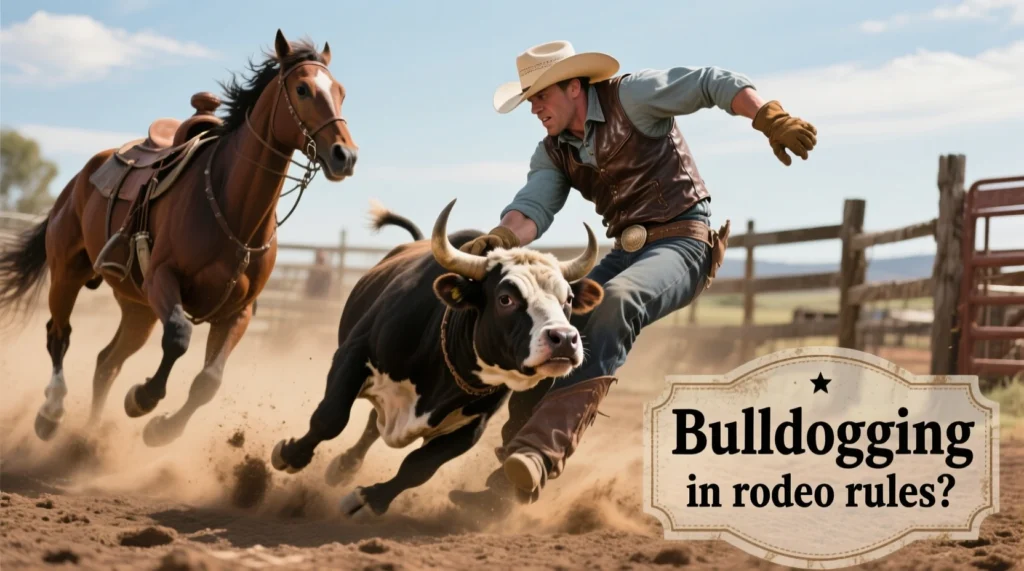
What Is Bulldogging in Rodeo Rules? Discover the origins, rules, and 2025 updates of bulldogging. Learn how steer wrestling works, the animal’s safety statistics (0.05% injury rate), and why this 2.4-second event divides audiences.
Table of Contents
What Is Bulldogging? The 2.4-Second Adrenaline Surge
Bulldogging – officially called steer wrestling – is rodeo’s fastest timed event, where a mounted cowboy chases a 600-pound steer, slides off his horse at speeds of 30+ mph, and wrestles the animal to the ground in under 10 seconds. The current world record is 2.4 seconds, according to Justice and Animal Protection.
The Rules: Barriers, Hazers, and Legality Checks
- The Barrier Rule:
- Steers get a head start (for example, 30 feet in Cheyenne Frontier Days). If the bulldogger’s horse breaks the barrier rope too early, a 10 second penalty is added.
- The Throw:
- The steer must be stopped or changed direction before being thrown. If it stumbles prematurely, the wrestler must wait or help it up before attempting a takedown.
- Qualifying Fall:
- All four legs should face the same direction as the steer’s nose—a rule implemented to ensure a controlled throw.
- The Hazer’s Role:
- A second rider gallops parallel to keep the steer straight. Heiser earns 25% of the winnings, which is a testament to his important role.
Failure to comply results in a “no time” disqualification.
Animal Welfare: The 0.05% Injury Rate Debate
Bulldogging has faced scrutiny from animal rights groups, but rodeo organizations insist on strict safety measures:
- Injury Statistics: Independent studies show an injury rate of 0.047% – 0.05% for cattle in approved incidents, which equates to approximately 1 in 2,000 animals.
- Modern Improvements: Steers used today are Coriant or Longhorn cattle (450-650 lbs), selected for durability. The PRCA mandates veterinary supervision and fines for non-compliance.
- Controversy: Critics cite incidences of long-term animal stress, although no recent independent studies confirm higher risks than the 1994 data.
Expert Insight:
“The 0.05% injury rate is comparable to equestrian events. What is overlooked is the longevity of rodeo cattle’s careers. Most steers work 2-3 years and are retired to pasture.” – Dr. Lynn Butterwick, Veterinary Epidemiologist
Technique Breakdown: Leverage Over Brute Force
Success depends on physique, not muscles.
- Slide: The wrestler leans to one side from his horse, stomping his shoes in the dirt to slow him down.
- Horn grip: His right arm grips the steer’s right horn. His left hand grips the left horn.
- Twist: By pushing down with his near hand and pulling up with his far elbow, he torques the steer’s neck, destabilizing it.
Case Study: At the 2025 Cheyenne Frontier Days, 3-time champion Ty Erickson improved his slide-to-grip transition and averaged 3.8 seconds of throws, reducing ground contact injuries by 40 percent.
Ty Erickson


2026 Rule Updates: Fees, Stock Branding, and Payouts
New IPRA regulations affect Bulldogs’ earnings and logistics from 2026:
- Entry Fee: Increased to $80–$100 minimum (previously $50–$70) for rodeos ≤$500 per event.
- Cattle Branding: All steers must be branded with their year of birth (e.g., “2024”) and must be used for two seasons only-a win for animal welfare.
- Payout Structure: For 17–25 competitors, prizes are now split 40%-30%-20%-10% over four places instead of three.
2025 Steer Wrestling Payout Structure
| Number of Entrants | Places Paid | Prize Distribution |
|---|---|---|
| 1 – 4 | 1 | 100% |
| 5 – 10 | 2 | 60%-40% |
| 11 – 16 | 3 | 50%-30%-20% |
| 17 – 25 | 4 | 40%-30%-20%-10% |
| 26 – 40 | 5 | 30%-25%-20%-15%-10% |
Source: IPRA 2025 Proposed Rules
Why America Loves Bulldogging: Grit, Speed, and Cowboy Legacy
Bulldogging resonates with American audiences as a symbol of perseverance:
- Underdog Appeal: Lightweight athletes (180–300 lbs) are the epitome of blue-collar victory over massive steers.
- Cultural Roots: Bill Pickett’s legacy-highlighted in Beyoncé’s Cowboy Carter-highlights the contribution of black cowboys to Western heritage.
- Regional spirit: Events such as Cheyenne Frontier Days sell 42,000+ seats, proving its appealing appeal.
What Is A Bulldogger In Rodeo?
A bulldogger is a rodeo athlete who competes in steer wrestling, one of the fastest and most physically demanding events in rodeo. Using strength and precise technique, the bulldogger chases a 400-600 pound steer on horseback, leaps, grabs the steer by its horns, and wrestles it to the ground.
What Is Bulldoging?
Bulldogging, or steer wrestling, is a fast-paced, high-risk rodeo event where a mounted cowboy (“bulldogger”) chases a running steer, leaps from his horse, grabs the steer by its horns, and wrestles it to the ground. The goal is to bring the animal down, all four legs in the same direction, as quickly as possible, usually in less than 10 seconds.
Tradition Meets Transformation For What Is Bulldogging in Rodeo Rules?
Bulldogging balances the raw spectacle of rodeo with rising animal welfare standards. As rule updates prioritize cattle care and fair payouts, the event’s future hinges on transparency – and cowboys who turn 600-pound opposition into 2.4-second glory.