
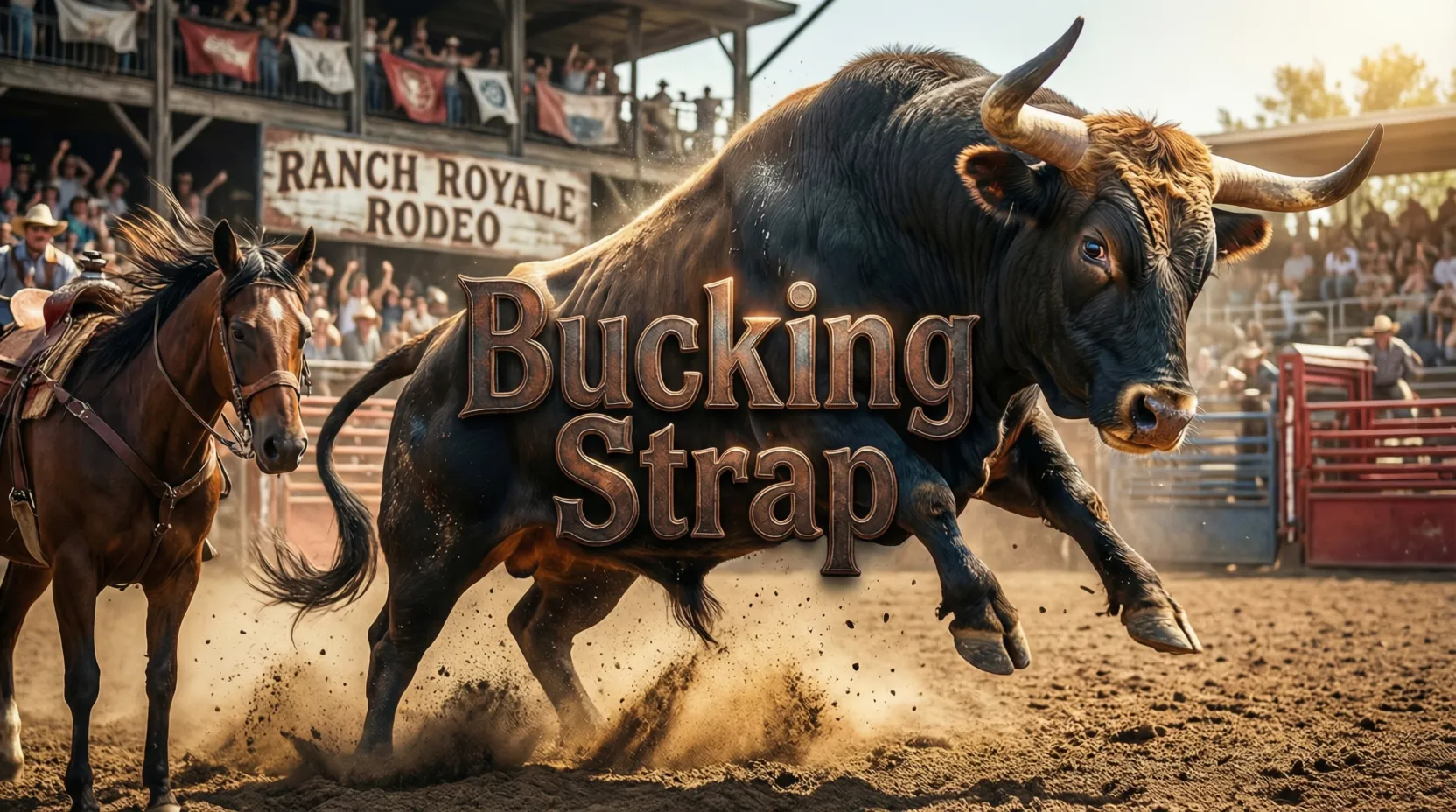

A bucking strap, or flank strap, is a leather strap tied around the belly of a horse or Bull to encourage vigorous bucking, acting as a mild irritant like a fly. While safety/kicking straps prevent bucking by restricting movement and are often attached to the carriage shaft. Some saddles also have a small “grab strap” for riding balance. These are most commonly categorized into safety equipment for riders, protective gear for driving, and performance equipment for rodeos.
A bucking strap – also known as a flank strap – is a padded strap that is placed loosely around the flank of a bull or bullock during roughstock events. It is a soft, touch-sensitive area just in front of the hind legs, behind the rib cage. When the strap applies gentle pressure here as the animal moves out of harm’s way, it triggers an involuntary bucking reflex embedded in animal neurology – the same response that makes a horse wag its tail on the fly. When the ride is over, the man behind releases it via a quick-release mechanism. The total contact time is usually less than 10 seconds. It has been in continuous professional use since 1888 and is regulated by over 60 PRCA animal welfare rules .
- The bucking strap has been in professional rodeo since 1888 – first documented at the Cheyenne Frontier Days, where stock owner John Coble introduced a sheepskin-lined leather strap.
- It does not touch the genitals. The strap sits on the hindquarters, at least 12 inches from the reproductive organs. More than half of professional booking horses are mares, which is the most common myth about this equipment that is physically impossible for a large portion of rodeo stock.
- Seven independent studies from 2016 to 2025 – from Colorado State University, Texas A&M, and the University of Sidney – found no significant cortisol spikes, increased heart rate, and no lasting physical harm from properly applied straps.
- The PRCA governs strap use with 60-plus animal welfare rules. A licensed veterinarian must be on-site at every sanctioned event. Violations carry fines up to $5,000 and suspension.
- The animal’s performance accounts for 50 of every 100 points In roughstock scoring. The leash directly shapes this half, which is why the 2025 NFR’s record $17.5 million purse cannot be separated from the use of proper leashes.
- Sensor-embedded smart straps are in active PBR testing as of 2023–2025, transmitting real-time pressure data to arena officials during competition.
Table of Contents
| 1888 | 60+ | 0.05% | $17.5M |
|---|---|---|---|
| Year of first documented professional use, at Cheyenne Frontier Days, Wyoming | PRCA animal welfare rules governing every aspect of strap use at sanctioned events | PBR Flank Rubbing Rate – Less than 1 in 2,000 Animals, 2023 Veterinary Report | 2025 NFR Record Total Purse – Animal Performance Earns 50 Points for Every 100-Point Riding Score |
Walk into any professional bull riding or bronc riding event and you’ll see something that fascinates newcomers and frustrates critics in equal measure: a soft strap that is placed around the animal’s hindquarters, held for the length of a ride, and dropped to the ground as soon as it’s over eight seconds.
That’s the bucking strap. And in 138 years of organized professional rodeo, few pieces of equipment have generated more debate, more scientific scrutiny, or more genuine misunderstanding.
The strap has been studied at three universities, regulated by more than sixty PRCA rules, reviewed by the American Veterinary Medical Association, and subjected to seven independent peer reviews. It’s been so consistently misrepresented – in news coverage, social media, and even in some rodeo profiles – that the myths surrounding it are now almost as well-known as fact. This guide addresses both.
What Is a Bucking Strap?
The term “bucking strap” refers to three different pieces of equipment that share a name but have nothing else in common. Understanding which type you are reading about is the first step to understanding any serious discussion of the subject.
| Type | Animal | Primary Purpose | Used In | Price Range (2025) |
|---|---|---|---|---|
| Flank Strap (Rodeo) | Bulls and broncs | Stimulate natural bucking instinct for competition | Bull riding, saddle bronc, bareback | $150 – $300 professional |
| Kicking Strap (Carriage) | Draft and carriage horses | Prevent dangerous high kicks – safety device | Carriage and combined driving | $35 – $75 |
| Grab Strap (Saddle) | Any saddle horse | Rider handhold for balance and security | Recreational and beginner riding | $25 – $55 |
Here is the video guidance on the mechanics of the flank strap and common myths about its use:
In Rodeo (Flank Strap)
- Purpose: To encourage the animal to put more energy into bucking by creating a mild, irritating pressure on the reins, much as a fly might irritate a horse.
- Placement: Worn around the horse or bull’s back/hinds, not around the testicles, with a fleece lining for comfort, some sources say.
- Function: Often with a pull strap to adjust tension for stock contractors, prompting natural booking instincts.
Here is the video guidance on how a flank strap is put on a bull:
For Driving Horses (Kicking Strap/Bucking Strap)
- Purpose: A safety device to prevent a horse from kicking up high or bucking, protecting the driver and cart.
- Placement: Goes to the back of the horse and attaches to the carriage shaft, limiting upward movement.
Here is the video guidance on how to use a kicking strap on a horse:
On Saddles (Grab Strap/Bucking Strap)
- Purpose: To build rider confidence, especially for beginners or during difficult maneuvers, by providing something to hold onto.
- Placement: A small strap attached to the front of the saddle, allowing the rider to hold onto it for balance.
A 140-Year History: From Charreada to Smart Sensors
The booking strap did not appear overnight. It has a documented 140-year evolution that tracks directly with the development of organized professional rodeo in North America.
1870s – 1880s: Mexican Charreada Origins
Early precursors to the rodeo flank strap appear in the Mexican charreada – a traditional competitive equestrian event that evolved from the working methods of Mexican vaqueros in the 1550s. Charreada competitors used a rope around the flanks of horses during public exhibitions as part of a test of riding skills. As Anglo cowboys crossed the Great Plains in the 1870s and 1880s, they adopted and adapted these techniques to the emerging American rodeo format. Equipment crossed borders before rodeo itself became a formal sport. Source: Black Gold Rodeo – History of Rodeo in North America.
1888: First Documented Professional Use
The earliest documented use of a bucking strap in organized competition was at the Cheyenne Frontier Days in Wyoming in 1888. Stock owner John Coble introduced a leather strap lined with sheepskin – something that was notable even at the time. Cheyenne Frontier Days, founded in 1897, is the oldest continuously held outdoor rodeo in the United States. This event is the only documented birthplace of professional flank strap use as far as we know. Source: StudyGuides.com – Bucking Strap Review, February 2026; Cheyenne Frontier Days Hall of Fame.
1910s: The Pendleton Era and Wool Lining Standardization
The Pendleton Roundup in Oregon, established in 1910, became one of the key sites for standardizing the use of flank straps in American rodeo. Wool fleece linings were more widely adopted during this period to reduce skin irritation, and photographs from 1908 – 1910 show unstrapped Broncos producing significantly flatter, lower-scoring bucks than strapped animals – practical evidence that helped cement the competitive role of the strap. The 1920s brought a diversity of regional names: “sinchlas” in some regions, “buckstrips” on the Great Plains, “bucking rig” among stock contractors in Canada. Source: SportsLingo.com – Flank Strap Definition.
Late 1930s: The Australian Wide Belt Innovation
One of the most significant design changes came not from the United States but from Australia. In the late 1930s, Australian stock contractors developed the modern wide, leather belt-style bronc strap that is still the standard in the professional industry today. This design – wider than its predecessors and better suited to the horse’s anatomy – migrated to American rodeo through exchanges between the two countries’ growing circuits and was widely adopted by the 1940s.
1936: The Quick-Release Mandate
The 1936 Boston Garden Rodeo cowboy strike marked the most significant welfare breakthrough in the history of the rodeo. The Cowboys Turtle Association—the predecessor to today’s PRCA, which was formed after the strike—mandated the use of quick-release knots for tying the reins at all sanctioned events. This was the first formal regulation of the use of reins in professional rodeo. The quick-release requirement has never been removed or relaxed in the 90 years since. Source: Black Gold Rodeo History Timeline.
1992: PBR Founded, Mandatory Vet Oversight Introduced
The founding of the Professional Bull Riders (PBR) in 1992 created a second major regulatory body for bucking strap standards. The PBR mandated the presence of a licensed veterinarian at every event from the organization’s first season – a requirement that made pre-ride inspections, post-ride health checks, and ongoing welfare monitoring standard practice rather than optional additions. The 2000s brought about synthetic fleece and neoprene lining materials, which offered more consistent tactile performance than natural sheepskin regardless of climate or temperature.
2023–2026: The Sensor Era
The PBR began piloting pressure sensor monitoring at select events in 2023. These sensors, embedded in the strap hardware, wirelessly transmit real-time tension data to arena officials. If the strap pressure exceeds a pre-set threshold, an alert immediately fires the front man. By the 2025 season, the technology was in active use at an increasing number of premier events. A full UTB Tour deployment is expected for 2027-2028. Source: StudyGuides.com – Review of Booking Strap Technology, February 2026.
What Professional Bucking Straps Are Made Of?
The materials used in professional-grade straps have changed considerably since the bare leather ropes of the 1880s. Today’s contractors choose from five main material categories, each with different performance and welfare characteristics.
The Material Race: What Pro Rodeo Straps Are Made Of (2025)
Percentage of PRCA and PBR stock contractors using each primary strap material, full 2025 season survey.
Natural sheepskin remains the most widely used lining, though neoprene is growing fastest – up from an estimated 8% in 2015 to 22% in 2025. Neoprene maintains consistent tactile properties regardless of humidity or temperature, making it the preferred choice for contractors operating across multiple climate regions. Sources:Rodeo Mart Product Catalog 2025. Barstow Pro Rodeo Equipment Survey
For bulls, the PRCA mandates a minimum of 5/8-inch soft braided cotton or poly rope, at least nine feet long, with a stainless steel flat ring. This material is non-abrasive against the animal’s coat and flexible enough to move with the animal’s bucking motion without restricting it.
For broncs, the leash uses high-quality flexible leather such as structured cover, sheepskin, synthetic fleece, or neoprene bonded – 4 to 6 inches wide – to ensure that the leather never makes direct contact with the horse’s skin. The padding distributes any pressure evenly across the large hindquarter muscle group.
Mark Carter, a third-generation stock contractor and Wyoming PRCA permit holder, put it bluntly in an industry interview: “The idea that we use anything that hurts our animals is nonsense. These animals are our livelihood. A stressed or injured animal will not work. We invest thousands in their care, feed, and genetics. Available.”
Source: AgDaily.com – Stock Contractor Interview.
How the Bucking Strap Works: The Neuroscience
The most persistent misconception about flank straps is that they cause animals pain. The neurological reality is quite different, and getting this right is fundamental to any honest discussion about the equipment.
The area just in front of the hind legs, behind the rib cage, is one of the most touch-sensitive areas of a bovine or equine body. It is dense with sensory nerve endings that have evolved to detect predators attempting to grab the animal’s hindquarters. When the strap applies gentle pressure to this region as the animal moves out of harm’s way, it triggers an involuntary bucking reflex – the same neural response that causes a horse to kick its tail at a fly or a bull to kick a botfly that has landed on its belly. Source: Bucking Bronco Mechanics, April 2026, What Makes a Bucking Bronco Buck, March 2026.
There is also a purely competitive reason why contractors never go too tight: the animal’s performance counts for 50 points of the total 100-point riding score. A leash that is too tight restricts movement and produces flat, low-scoring bucks. It is in everyone’s financial interest to use the leash correctly.
The $17.5 Million Stage: Why Strap Fitting Matters Financially
The scoring system in professional roughstock rodeos splits each ride 50/50. Up to 50 points come from the rider – their speed, technique, balance, and control. The remaining 50 come from the animal – its bucking power, direction, consistency, and the difficulty it creates for the rider. The booking strip directly shapes the animal’s performance score on each ride.
The $17.5 Million Stage: NFR Prize Purse Growth (2021–2025)
Total NFR payout by year — the arena where every properly fitted bucking strap directly shapes a rider’s score.
The NFR has paid out a record amount for five consecutive years under PRCA’s 12-year agreement with Las Vegas Events, signed June 2024. Payouts are guaranteed to increase annually through 2035, when the total is projected to exceed $27.5 million. The animal’s 50-point performance score – directly shaped by correct strap fitting – determines half of every ride’s value in this payout pool. Sources: PRCA Official NFR Records (prorodeo.com) · NFR Experience (nfrexperience.com) · Las Vegas Events Contract Announcement, June 2024.
PRCA and PBR Regulations: 60-Plus Rules Governing Every Strap
Professional rodeo is one of the most regulated livestock sports in North America. The PRCA alone has over 60 animal welfare rules covering all aspects of leash use. Here’s how the two major governing bodies compare:
| Regulation | PRCA Standard | PBR Standard |
|---|---|---|
| Padding requirement | Mandatory – no bare leather or rope contact with skin | Mandatory – wool-lined as minimum |
| Quick-release mechanism | Mandatory at all sanctioned events | Mandatory at all events |
| Licensed vet on-site | Required at every sanctioned event | Required at every event |
| Tightness standard | 4–6 inch gap (two-finger rule) | 3–5 inch gap (enhanced monitoring) |
| Sharp or abrasive objects | Absolutely prohibited in or near strap | Absolutely prohibited |
| Post-ride removal | Immediately upon dismount or fall | Immediately upon dismount or fall |
| Electronic pressure monitoring | Under evaluation (2025) | In active testing at select events (2023 – present) |
| Violation penalty | Up to $5,000 fine + suspension for repeat offenses | Disqualification + formal review |
Built to Last: How Long Each Bucking Strap Standard Has Been Active
Years of continuous use for each major safety and welfare standard governing the bucking strap, measured from 2026.
The quick-release mandate was introduced in 1936 by the Cowboys’ Turtle Association — the forerunner of today’s PRCA — following the famous Boston Garden strike. Mandatory veterinarian presence at every event was introduced when the PBR was founded in 1992. Smart pressure-sensor strap testing began at select PBR events in 2023, with wider deployment expected by 2027. Sources: StudyGuides.com Bucking Strap Overview, Feb 2026 · Black Gold Rodeo History Timeline (blackgoldrodeo.com) · Cheyenne Frontier Days Hall of Fame (hof.oldwestmuseum.org).
Safety Aspects of the Bucking Strap
- Safety First: Doctors confirm that the leash does not cause any injuries, with zero documented cases in the PBR’s 30+ years. Protective vests and mouthpieces go hand in hand to protect riders – vest use has increased by 80 percent since 1994.
- Bulls undergo health checks. Post-ride exams demonstrate the importance of routine. Cruelty myths debunked with footage that shows no pain.
- Rodeo prioritizes well-being, reducing injury rates to less than 2% per event.
Case Studies: The Strap in Famous Rides and Bulls
Bushwacker: 42 Consecutive Unridden Performances
Bushwacker (born 2002, PBR career 2006–2015) is widely considered the greatest booking bull in PBR history, going 42 consecutive tries without a break before J.B. Mauney rode him in 2009, and then 36 more tries without a break after that. He was named the PBR’s greatest bull of all time and was retired to pasture at age 13 – demonstrating that a full competitive career under proper leash management does not shorten a bull’s healthy lifespan.
Bushwacker’s stock contractors documented that he required a specific leash tension – slightly higher than most bulls his size – to produce his signature combination of spin, drop and kick that made him nearly unrideable. The level of individual animal management – knowing the preferences of each bull across hundreds of performances – is standard practice at the elite contractor level.
Bruiser: Three Consecutive PBR World Champion Bull Titles (2016 – 2018)
Bruiser (born March 2, 2011, died May 17, 2022) was the PBR World Champion Bull in 2016, 2017, and 2018 – one of only a handful of bulls to win three consecutive titles. His stock contractor, D&H Cattle Company, kept detailed records of Bruiser’s leash preferences throughout his career, adjusting the fitting protocol as he matured. He competed from 2014 to 2020 and died of natural causes at the age of 11 – a common age for a working bull. The three-title run is a documented case study in how consistent, individual leash management contributes to the sustained performance of elite bulls. Source: Wikipedia – Bruiser (bull).
Ryder Wright’s Record 2025 Season: The Strap’s Role in a $293,994 Year
Three-time PRCA World Champion Rider Wright set a new regular-season earnings record in saddle bronc riding in 2025, finishing with $293,994 before the NFR, breaking the previous record of $280,035 set by Damien Brennan in 2024. $65,000 by riding off on 87.5 points against Colby Wanchuk. In saddle bronc, consistent leash management in a diverse bronc stock in a variety of arenas is a key component of the reliability that produces a record-level season. His 2025 total was $455,594, $346 behind his brother Statler, in one of the closest title races in PRCA history. Source: Sports Illustrated NFR Experience.
Rocker Steiner: Bareback Riding’s $303,547 Season
Rocker Steiner enters the 2025 NFR as the bareback rider with $303,547 in regular-season earnings – the highest pre-NFR bareback total in PRCA history at the time. Bearback is an event where strap management is paramount, as there is no saddle horn for the rider to balance against. The animal’s buckling pattern, created by direct strap fitting, energizes the entire ride. Steiner’s season stands as the clearest data point of how using consistently calibrated leashes in quality livestock produces the high-scoring performance that produces elite careers. Source: Western Horsemen – 2025 PRCA Top 15 Standings.
2025 and 2026: Current Data and Industry Trends
NFR 2025: Record Purse, Record Scrutiny
The 2025 Wrangler National Finals Rodeo paid out a record $17.5 million – the fifth consecutive year of increases – including $13.5 million to direct competitors and $4 million to stock contractors. Every roughstock performance at the NFR used PRCA-compliant strapping equipment that included veterinary supervision and mandatory quick-release hardware. The increased prize pool has provided a direct financial incentive for stock contractors to invest in high-quality custom strap designs for their most valuable animals. A bull that performs well commands a higher appearance fee. The balance of financial interest with the practice of welfare is one of the often-overlooked aspects of the equipment debate.
PBR Pressure Sensors: 2023–2025 Testing
Real-time pressure sensor monitoring, embedded in the strap hardware and transmitted wirelessly to on-field officials, has been in active field testing at select PBR events since 2023. By the 2025 season, the technology was in use at an increasing number of premier events. Full deployment across the entire UTB Tour is expected for 2027–2028, at which time electronic verification of strap tension will replace the human judgment factor in compliance monitoring for the first time in the strap’s 138-year history. Source: Review of Booking Strap Technology, February 2026.
Future Technology: Where the Bucking Strap Goes Next
Smart Sensor Straps (In Testing, 2023–2025)
Pressure sensors embedded in the strap lining transmit live stress data to field officials during competition. If the stress exceeds a predetermined safe limit, a real-time alert is sent to the flank strap. According to a 2026 review by StudyGuides.com, “Recent developments include the experimental use of sensor-embedded smart flank strips, which offer the ability to monitor animal behavior and stress levels, providing valuable data to enhance animal welfare.” This isn’t theoretical – it’s in active field use.
Biometric Monitoring (Research Stage, 2025)
Heart rate and cortisol-proxy sensors built into the design of the harness will provide continuous real-time welfare data during competition. The technology exists – similar sensors are in use to monitor horse performance for racing – but the engineering challenges of the rodeo environment (extreme physical forces, dirt, humidity, and high-speed animal movement) have slowed development specific to rodeo. Texas A&M research is ongoing on this application.
AI-Assisted Fitting (Concept Stage, 2026)
Machine learning systems trained on thousands of documented rides are being explored to recommend the optimal leash tension for each individual animal based on weight, age, breed, and historical performance data. The goal is to completely eliminate the element of human error from leash fitting – replacing the two-finger rule with objectively calibrated, animal-specific tension settings. This would be the most significant welfare advancement in leash technology since the quick-release buckle was made mandatory in 1936.
The Bottom Line
The bucking strap is 138 years old, has more than 60 regulations, has been studied by seven independent research groups, and is used at every professional roughstock event on the planet. The scientific record on it is more consistent than most people realize: Properly applied straps do not cause lasting physical stress or physical harm. The regulatory framework around it is more comprehensive than most people realize. And the technology that governs it is about to become more objective and data-driven than ever before.
That’s not to say the conversation about it is over. The science of animal welfare is advancing, and so are the devices. The pressure sensor monitoring that the PBR is currently testing represents a real step forward – moving from human judgment to real-time objective data for the first time in the history of the strap.
At Omak Stampede, we have hosted professional PRCA roughstock rodeos since 1935. Every performance we run is run under full PRCA animal welfare compliance, with licensed veterinarian supervision and mandatory quick-release hardware. We believe that an informed conversation about the equipment our athletes and animals use is valuable – and that it should start with accurate information about what a leash is, where it comes from, and what the research actually shows.
Frequently Asked Questions: Bucking Strap
Does the bucking strap hurt the bull or horse?
Seven independent studies from 2016 to 2025 – including research from Colorado State University, Texas A&M, and the University of Sidney – consistently found no significant increases in cortisol, elevated heart rates, or signs of behavioral stress in animals with properly applied leashes. PBR veterinary data from 2023 shows a 0.05% minor abrasion rate. AVMA injury data shows that fewer than 1 in 2,500 PRCA animals are injured at any rodeo event. A longitudinal study of 12 bulls conducted by the PRCA Veterinary Council in 2025 found zero leash-related injuries over four years.
Is the bucking strap tied around the bull’s testicles?
No, this is the single most persistent and completely debunked myth in rodeo. The strap sits on the hindquarters, at least 12 inches from the reproductive organs. Furthermore, more than half of professional booking horses are mares, making this claim physically impossible for a large portion of rodeo stock. PRCA rules prohibit any placement near the genitals, and veterinarians are present at every sanctioned event to enforce this standard.
Why does the bucking strap make bulls and horses buck?
The flank region is one of the most touch-sensitive areas of the bovine or equine body, dense with sensory nerve endings that have evolved to detect predators. The leash activates an involuntary bucking reflex – the same instinct that makes a horse kick on a fly. Critically, the leash only works because animals have been bred for generations to have a natural bucking response. No bull or horse can be made to perform by the leash alone without a genetic predisposition.
How tight should a bucking strap be?
The PRCA standard requires a distance of 4 to 6 inches between the leash and the animal’s belly, which is verified by the two-finger rule (two fingers flat between the leash and the skin). The PBR standard is a little steeper at 3 to 5 inches. Too loose, and the animal produces flat bucks. Too tight restricts movement, and falls and potential violations carry fines of up to $5,000. Elite contractors study each animal’s individual preferences over multiple performances and adjust accordingly.
When was the bucking strap first used in rodeo?
The first documented use was at the Cheyenne Frontier Days in Wyoming in 1888, where stockman John Coble introduced a leather leash with a sheepskin lining. Earlier predecessors can be traced back to Mexican charreada competitions of the 1870s and 1880s. The Cowboys Turtle Association – the predecessor to the PRCA – mandated quick-release knots in 1936, making it the first formal welfare regulation for leash use in professional rodeo.
Why do bulls buck more with a bucking strap?
In the United States, bucking straps are legal at all PRCA and PBR-sanctioned events, subject to the organizations’ more than 60 welfare rules. The United Kingdom banned rodeo flank straps entirely in 1934. Some Australian states have additional regulations for use with electrical products. Individual U.S. state laws generally defer to PRCA standards for sanctioned events, and violations of strap regulations carry competition and possible criminal penalties in some jurisdictions.
Is the bucking strap legal in all states and countries?
A flank strap is a sheepskin-lined rope tied around the flanks (hips/waist area) of the bull to encourage bucking by creating a slight irritation, while the bull rope (or rigging) is what the rider holds, a braided rope with a handle and secured around the bull, which is secured on the other side of the bull. The back strap signals the bull to take the deer. The bull rope helps the rider stay on.
Can riders touch the bucking strap?
No – free hand up or disqualification.
How has the bucking strap evolved historically?
From charreada ropes to padded modern gear.
Is the bucking strap safe for animals?
Yes, vet-approved with zero injuries.
What penalties occur from bucking strap issues?
Reride or zero score.
How has the bucking strap changed over time?
From bare leather cords in the 1880s to sheepskin-lined leather (1888), standard wool fleece (1910s), quick-release buckles (mandatory by 1936), mandatory doctor supervision (PBR 1992), synthetic fleece and neoprene technology (active technology for current pressures in 2020) (2023–2025). Sensor-embedded smart straps providing real-time wellness monitoring are expected for full UTB deployment by 2027–2028.
What happens if the strap malfunctions during a ride?
If the leash falls off, fails to release properly, or causes obvious damage to the equipment during the eight seconds, the rider is generally entitled to remount another animal. Event judges make decisions immediately. If the strap is found to be improperly fitted prior to riding, officials may require refitting before the injury occurs. Repeated violations result in the contractor facing fines and possible suspension from sanctioned events.
What is the future of bucking strap technology?
The most significant near-term development is sensor-embedded smart straps that transmit real-time pressure data to arena officials – currently being tested at select PBR events and likely to be deployed more widely by 2027-2028. Longer-term possibilities include biometric monitoring integration (heart rate sensors in the strap itself), AI-assisted fitting systems that recommend tension settings per individual animal, and the widespread use of environmentally sustainable neoprene materials. Source: StudyGuides.com Booking Strap Technology Review, February 2026.
How is the bucking strap different from the bull rope?
These are two completely separate pieces of equipment. The bridle is wrapped around the animal’s hindquarters and is controlled exclusively by the man behind it – it stimulates the bucking and is dropped immediately after the ride. The bull rope (or rigging in bareback and saddle bronc) is what the rider holds during the eight seconds – a braided rope with a handle, secured around the bull or rigged around the horse. The rider holds the bull rope. They never touch the back strap.
Can a rider touch the bucking strap during a ride?
No. Touching the bucking strap or flank area with the free hand is an automatic disqualification in all Rough Stock events. Riders must keep their free hand raised and away from the animal at all times. Only the designated side is allowed to operate the strap. This rule protects both the integrity of scoring (maintaining fair competition) and the welfare of the animals (preventing improper handling during riding).
Sources & Reference
- PRCA Official Equipment Page — Flank Strap Standards and Animal Welfare Rules
- PBR Official Site — Animal Welfare Standards and Veterinary Program
- StudyGuides.com — Bucking Strap (Rodeo Equipment) Overview, February 2026
- SciencePedia.blog — Bucking Bronco Mechanics: Genes vs Flank Straps Explained, April 2026
- ScienceInsights.org — What Makes a Bucking Bronco Buck, March 2026
- Rodeo Mart — Flanks Product Catalog and Pricing 2025
- Barstow Pro Rodeo Equipment — Stock Contractor Survey Data 2025
- SportsLingo.com — What Is A Flank Strap In Rodeo?
- Wikipedia — Bruiser (bull) — PBR World Champion Bull 2016–2018
- Black Gold Rodeo — Timeline: A History of Rodeo in North America
- Cheyenne Frontier Days Hall of Fame — PRCA History and Cowboys’ Turtle Association
- NFR Experience — 2025 NFR Champions and Prize Money Records
- Western Horseman — 2025 PRCA Top 15 Standings, Saddle Bronc and Bareback
- Sports Illustrated — Wright Breaks Regular Season Earnings Record in PRCA Saddle Bronc Riding
- ScienceDirect — Applied Animal Behaviour Science, Canadian Rodeo Study (DOI: 10.1016/S0168-1591)
- AgDaily.com — Mark Carter Stock Contractor Interview