
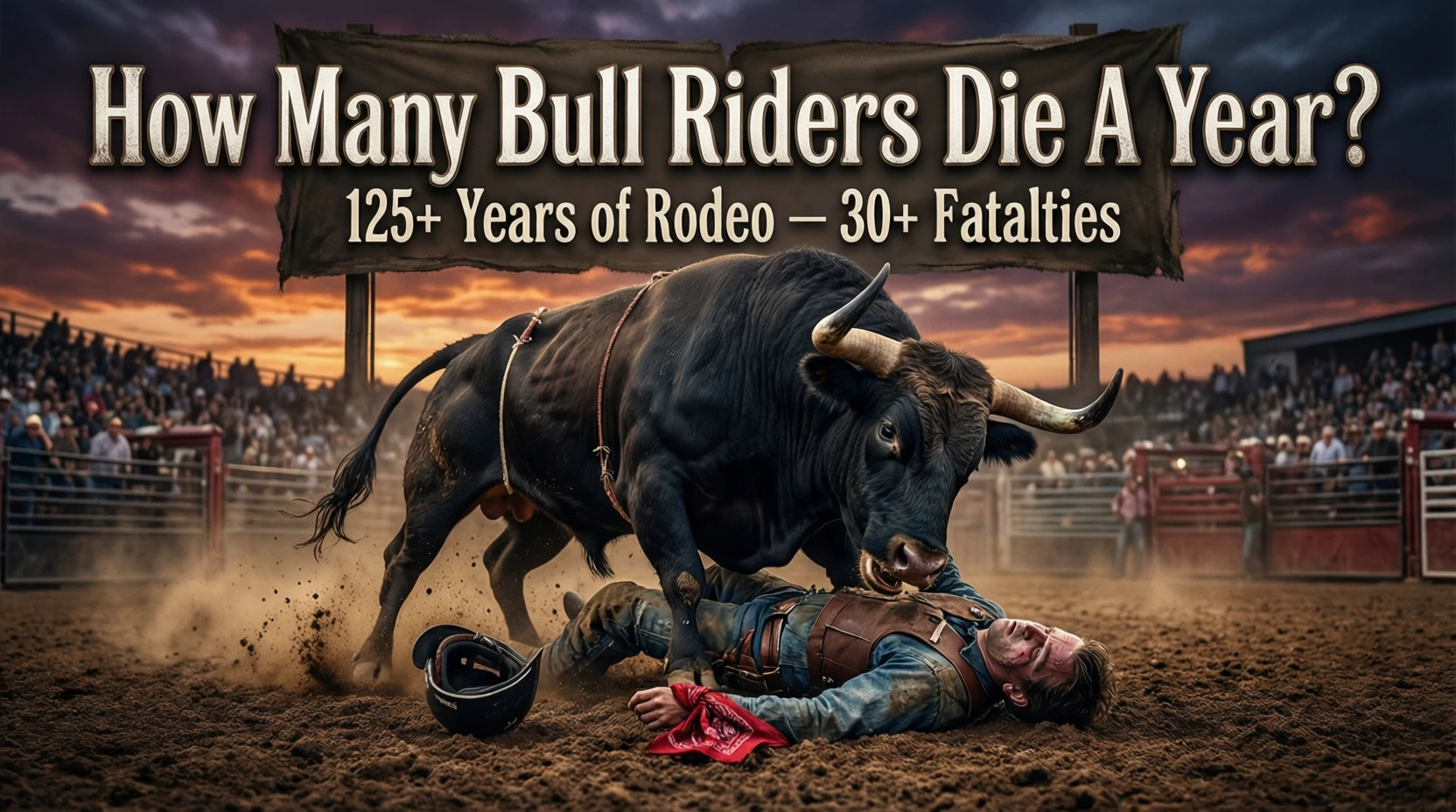
How Many Bull Riders Die A Year? In the professional rodeo circuit, bull riding fatalities average between 1 and 2 per year. Some broad estimates for all professional circuits give a range of 1 to 3 deaths per year. The professional rodeo circuit, although some sources suggest a slightly higher number, has had a total of about 20 professional deaths since 1989, highlighting the extreme danger of the sport, which results in many serious injuries annually.
Table of Contents
Key Statistics & Information
- Low frequency, high severity: Deaths are rare compared to the high rate of severe injuries like spinal cord or brain trauma, notes this article from WorkersCompensation.com and The Annals of Emergency Medicine.
- Specific incidents: Notable deaths include Mason Lowe in 2019 and Amadeo Silva in 2021, showing that fatalities occur at different levels of competition.
- Causes: Most catastrophic injuries and fatalities are caused by thoracic compression (impact to the chest) or head trauma, according to this article from cjsmblog.com and this PubMed study, often from a fall or direct impact.
Fatality And Injury Risk
- Mortality: The estimated death rate is about 4.05 to 7.29 per 100,000 participants.
- Professional Total: Since 1989, at least 21 deaths have been recorded in professional bull riding.
- Recent Cases: Deaths have continued into the current decade, such as Dylan Grant (24) in April 2025 and Amadeo Campos Silva (22) in late 2021.
- Catastrophic Injuries: In addition to fatalities, riders suffer a “catastrophic injury” rate of about 19.81 per 100,000 participants, including life-altering spinal cord or brain damage.
- Non-fatal Injury Risk: Bull riding is widely considered the most dangerous organized sport. Research shows a 5.06 percent chance of injury per ride, and the injury rate is about 10 times higher than in American football.
Putting the Danger: Bull Riding vs. Other Sports
To truly understand these numbers, it is important to compare them to other high-contact sports.
This data confirms what sports medicine experts say: Bull riding has an injury rate ten times higher than professional football. The force exerted by a bull’s hind legs is comparable to 30 times that of an Olympic boxer’s punch, highlighting the unique, violent physics of the sport.
The Evolution of Safety: Gear That Saves Lives
For decades, the culture of the sport has valued tradition over technology, with many riders preferring cowboy hats over helmets. That is changing due to statistics and tragedy.
- Helmets: The single most effective safety advancement. Research shows that riders wearing certified helmets have a nearly 50 percent lower risk of serious head injuries. The Professional Bull Riders (PBR) now requires helmets for all riders born after 1994.
- Protective vests: Modern vests use high-density foam and ballistic materials like Spectra Shield to absorb and distribute the impact of a kick or horn strike. While early studies have questioned their effectiveness against crushing force, they are important for reducing rib fractures and internal injuries.
- Arena safety: The presence of professional bullfighters (rodeo clowns) is non-negotiable. Their job is to distract the bull and take its attention away from the fallen rider, creating a critical window for escape. Immediate field-side medical care from specialized sports medicine teams has also dramatically improved the outcomes of seriously injured athletes.
Case Studies
In 2025, 24-year-old Dylan Grant died after being bucked off and trampled by a Texas rodeo buck. He was airlifted, but succumbed to his injuries. Mason Lowe’s 2022 PBR death involved a hoof to the chest, piercing his vest – highlighting the limitations of blunt force. This reduces the risks of chest injuries in 77.5% of bull incidents.
Expert Insights
Journal of Trauma study confirms chest/head injuries lead to fatalities, calls for better vests. PBR officials stress gear compliance; bull injuries are rare (0.0002%). Safety experts advocate full-face helmets and training, as inexperienced riders face increased risks.
Are you looking for a breakdown compared to previous legendary deaths, Rodeo Riders like Lane Frost & Mason Lowe?
I can provide a side-by-side comparison of their career earnings, Injuries and titles.
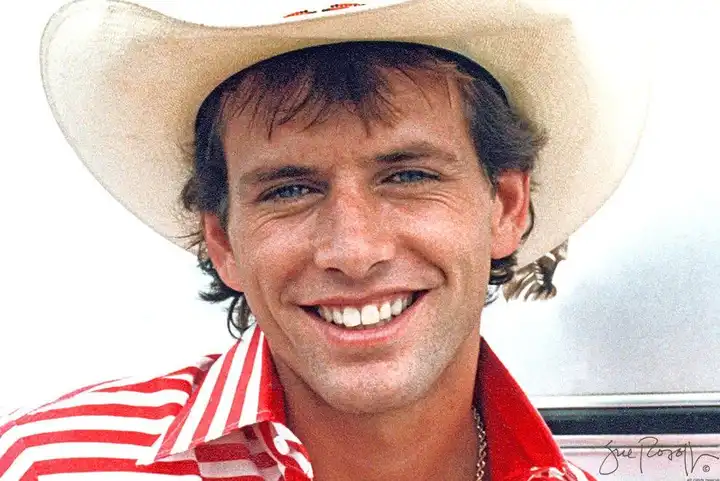
Lane Frost’s Death
or

Mason Lowe’s Death
Frequently Asked Questions: How Many Bull Riders Die A Year?
What is the most common injury in bull riding?
In bull riding, the most common types of injuries are sprains, strains, and contusions. These injuries are often less severe but occur with the highest frequency, usually affecting the lower and upper extremities.
Does safety gear really make a difference?
Protective gear is extremely effective in reducing the severity of injuries and preventing fatalities, especially in activities such as motorcycling and sports. While it cannot guarantee complete immunity from harm in extremely high-impact scenarios – such as collisions with stationary objects – it dramatically changes the odds of survival and recovery.
How many bull riders die yearly in PBR?
Rarely 1-3 pros, but overall, US rodeo nears 20 deaths per year.
The recorded deaths in PBR history include:
Amadeu Campos Silva (2021)
Mason Lowe (2019)
Glen Keeley (2000)
Are there any long-term health impacts for bull riders?
Yes. Even those who avoid catastrophic injury often suffer long-term effects. Studies note a high prevalence of degenerative joint disease, severe arthritis, and the potential for Chronic Traumatic Encephalopathy (CTE) from repeated head trauma.
What gear prevents deaths?
Kevlar vests, helmets, and vests reduce risks, but not 100%
What is being done to make the sport safer?
Major organizations like the PBR and PRCA are constantly updating the rules. This includes mandatory protective gear for new professionals, requiring on-site sports medicine teams, funding research into better vest technology, and enforcing animal welfare laws to ensure the health and predictable behavior of livestock.
Why so dangerous?
2,000-lb bulls trample at speed; 8 seconds feels eternal.
Scoring impact safety?
High bull scores incentivize tough animals, upping risks.
How Many People Have Died Bull Riding?
Bull riding is considered the most dangerous organized sport in the world due to its high injury rate.
Injury rate: Approximately 32 injuries per 1,000 rides.
Leading causes of death: Most deaths occur from being gored to the chest or back, or after suffering blunt force trauma and internal injuries.
Protective gear: Although flak jackets and helmets have become common or mandatory for young riders, they cannot prevent all fatal injuries caused by the bull’s heavy weight.
How Many Pbr Riders Have Died?
Since 1989, at least 20 professional bull riders have lost their lives due to injuries incurred during rodeo events, according to reports on various incidents, including those within the PBR (Professional Bull Riders) circuit.
Although injuries are frequent, deaths are comparatively uncommon, thanks to safety gear such as protective vests.
A Calculated Risk
So, How Many Bull Riders Die A Year? The answer is sadly more than zero, with no sport in the U.S. Bull riding consistently averaging one to three deaths per year. It is an extreme sport with life-or-death stakes, statistically proven to be more dangerous than any other major athletic pursuit.
The culture is gradually shifting from pure irony to one that embraces calculated risk – where courage is balanced with mandatory helmets, certified vests, and respect for the animal’s immense power. For riders, the thrill of the challenge far outweighs the perceived danger. For spectators and participants alike, acknowledging the obvious reality of the danger is the first step toward respecting the sport and the athletes who choose to face the beast.