


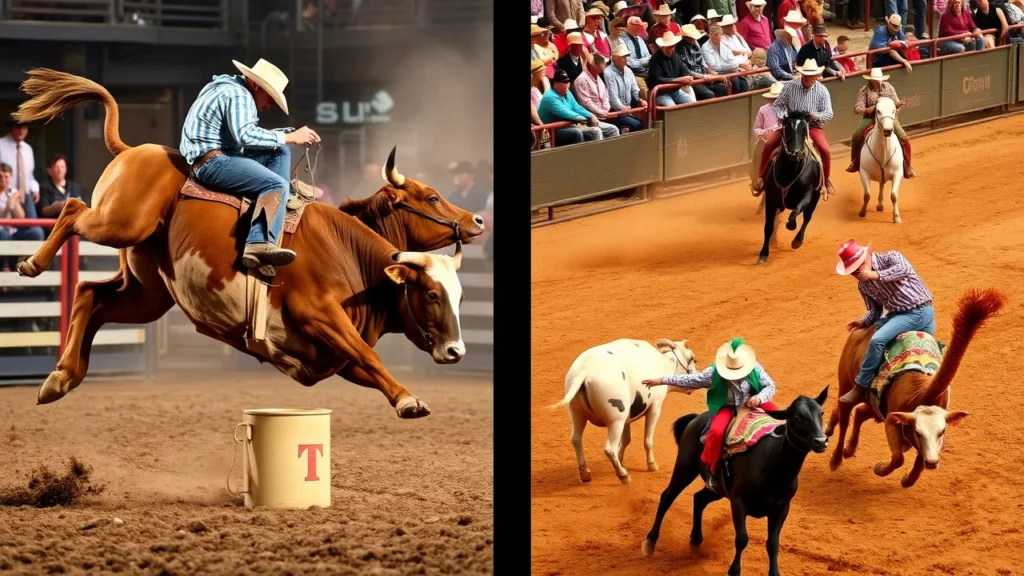
Is Bull Riding a Rodeo? Bull riding stands among rodeo’s three cornerstone roughstock events – with bareback and saddle bronc riding – while maintaining its identity as both a specialized sport (through PBR) and essential rodeo discipline within the eight-event Western competition tradition.
Table of Contents
Rodeo’s Complete Competition Structure
The Eight Standard Rodeo Events
Professional rodeo consists of Three main categories that showcase different Western skills:
Roughstock Events (Judged on Performance):
- Bareback riding – Cowboys ride bucking horses using only the rigging for eight seconds.
- Saddle bronc riding – Considered the “classic event of rodeo”, riders use a special saddle.
- Bull riding – Athletes attempt to ride bucking bulls for eight seconds, this is the most dangerous event.
Timed Events (Speed Competitions):
- Steer wrestling (bulldogging) – Cowboys jump off their horses to take steers to the ground.
- Team roping – Two riders work together to tie the head and hind legs of a steer with a rope.
- Tie-down roping (calf roping) – Riders rope and tie the calves as quickly as possible.
- Barrel racing – A primarily women’s event that involves running around a barrel in a cloverleaf pattern.
- Breakaway roping – A timed roping event where the rope breaks from the saddle.
Scoring and Competition Differences for Is Bull Riding a Rodeo?
In roughstock events, including bull riding, competitors receive a score that is based equally on both the rider’s performance and the animal’s performance. Two judges award 0-25 points for the rider and 0-25 points for the bull, for a maximum possible score of 100 points. Only one rider in professional rodeo history, Wade Leslie, has achieved a perfect 100-point ride on October 6, 1991, riding Wolfman Squall.
Bull Riding’s Unique Position Within Rodeo
The Most Dangerous Eight Seconds in Sports
Bull riding stands out as the most dangerous event in rodeo, accounting for 19.4% to 58.4% of all rodeo injuries. Research shows that bull riding has an injury rate of 28.5 to 48.2 per 1,000 competitor exposures, making it twice as dangerous as other rodeo events. Medical studies show that 36% of bull riding injuries are classified as serious, with 54.3% of head injuries requiring hospitalization.
Historical Origins and Development
Bull riding traces its ancestry to the 16th-century Mexican charreada, equestrian competitions that developed on colonial haciendas. Originally called jaripio, early bull riding was described as “a type of bullfighting where riders literally gore the bull to death”. The sport has evolved significantly over the centuries:
- 1850s: Charreada-style competitions become popular in Texas and California.
- 1936: The Cowboys’ Turtle Association (later PRCA) establishes standard rules.
- 1992: Twenty professional bull riders found the Professional Bull Riders (PBR), establishing bull riding as a standalone sport.
Modern Professional Organization and Economic Impact
Dual Sport Structure
Today, bull riding operates under two major organizational structures:
The Professional Rodeo Cowboys Association (PRCA) governs all traditional rodeo competitions. The PRCA sanctions approximately 790 rodeo events annually and oversees the National Finals Rodeo, which generates an economic impact of $200 million for Las Vegas.
The Professional Bull Riders (PBR) focuses exclusively on bull riding competition. PBR events attract more than 100 million viewers worldwide annually and average 864,000 viewers per broadcast on CBS. The organization holds more than 300 annual events in multiple countries, attracting more than 2.5 million spectators annually.
Economic Significance
The broader rodeo industry demonstrates substantial economic impact:
- The Houston Livestock Show and Rodeo generated an economic impact of $326 million in 2024, attracting 2.7 million attendees.
- PRCA membership reached 6,600 in 2023, the highest level in more than a decade.
- Total professional rodeo payouts surpassed $50 million after the National Finals Rodeo.
- More than 35 million people identify as fans of professional rodeo.
Safety Equipment and Modern Developments
Protective Gear Evolution
Bull riding safety equipment has advanced significantly, although usage rates vary considerably. Research shows that only 31% of bull riders ever report wearing a helmet, despite the fact that head injuries are the most common cause of serious trauma. Nearly all riders use protective vests, which provide moderate protection from impacts but do little to prevent crushing injuries if riders are trampled.
Modern safety innovations include:
- Kevlar protective vests are specifically designed for the impacts of bull riding.
- Specialized helmets with face guards to protect against bull kicks and horns.
- Neck support systems to reduce hyperextension injuries.
- Improved bull rope design with safety release.
Helmet Usage Challenges
Despite the clear safety benefits, helmet adoption faces resistance due to rider perceptions. Studies show that 17% of riders report that helmets restrict vision and 14% believe they impair riding ability. Additionally, secondary injuries such as traumatic ear lacerations have been documented when helmets move during impact.
Cultural Impact and Western Heritage
Traditional vs. Modern Evolution
Bull riding represents both traditional Western heritage and modern extreme sports entertainment. Within the comprehensive rodeo, bull riding serves as an element that preserves the full spectrum of ranching skills that defined American frontier life. As a standalone sport through the PBR, bull riding emphasizes individual athletic achievement and extreme sports thrills.
The Professional Rodeo Cowboys Association maintains the traditional rodeo culture, where bull riding exists alongside other events that showcase a variety of Western skills such as roping, steer wrestling, and bronc riding. This comprehensive approach preserves an authentic representation of the historic ranch work that gave rise to rodeo competition.
International Expansion
Bull riding has a global appeal, with PBR operating in the United States, Canada, Mexico, Brazil and Australia. In Brazil, bull riding is the second most popular televised sport after football, with more than 1,800 rodeos annually attracting 30 million spectators.
Integration, Not Separation
Bull riding is primarily one of the eight traditional events within rodeo, although it has also successfully developed as a standalone sport. Professional rodeo maintains bull riding as part of the overall Western competition, while the PBR has created a special entertainment format that focuses exclusively on eight-second bull rides.
Understanding this relationship makes it clear that bull riding represents both a core rodeo event and an independent sporting phenomenon. Traditional rodeo preserves the full cultural heritage of Western ranching skills, while stand-alone bull riding maximizes the excitement and danger of the sport’s most thrilling element. Both formats honor the Western tradition while serving different audiences and preserving different aspects of American frontier culture.
This dual existence ensures that bull riding continues to thrive as part of the comprehensive tradition of rodeo and as an extreme sports spectacle, providing multiple avenues for athletes, fans, and cultural preservation in the modern Western sports landscape.