
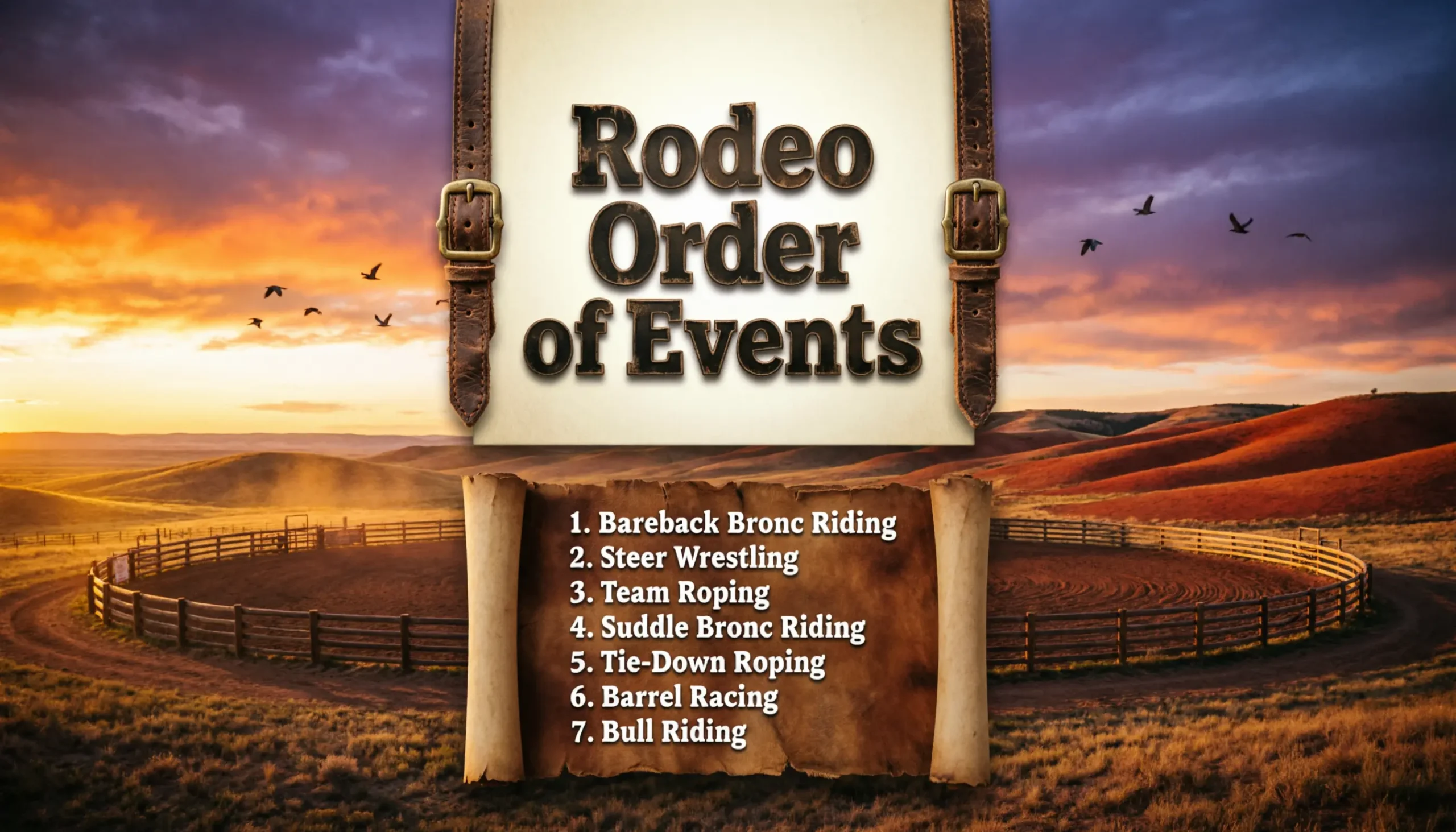
Rodeo Order Of Events, A standard professional rodeo (PRCA) typically follows this order to balance high-energy roughstock with timed events:
1. Bareback Riding,
2. Steer Wrestling,
3. Team Roping,
4. Saddle Bronc Riding,
5. Tie-Down Roping,
6. Barrel Racing,
7. Bull Riding.
The performance typically begins with opening ceremonies and features a combination of speed and power.
Table of Contents
Typical Rodeo Order Of Events
While each rodeo varies by organization and region or location, professional rodeos – especially those sanctioned by the Professional Rodeo Cowboys Association (PRCA) – generally follow a standard sequence of events.
- Bareback riding: Cowboys ride a horse with only the rigging (no saddle or reins) for eight seconds. A fast-paced, women’s timed event.
- See video ▶️ How to Ride Bareback Riding?
- Steer wrestling: Also known as “bulldogging,” a cowboy jumps off a horse to take a steer to the ground.
- See video▶️ How to do a Steer Wrestling?
- Team roping: Two cowboys (a headman and a heeler) work together to tie the steer’s horns and hind legs with rope.
- See Video▶️ How to do a Team Roping?
- Saddle Bronc Riding: The “Classic” rodeo event where riders must remain on the horse using a specific saddle and a single rein.
- See Video▶️ How to do a Saddle Bronc Riding?
- Tie‑Down Roping: A cowboy ties a calf to a rope, dismounts, and ties three legs as quickly as possible.
- See Video▶️ How to do a Tie-down roping?
- Barrel Racing: Primarily a women’s event, Female riders race around three barrels in a cloverleaf pattern.
- See Video▶️ How to do a Barrel Racing?
- Bull Riding: The final and exciting, dangerous event that Riders try to stay on the bull for eight 8 seconds.
- See Video▶️ How to do a Bull riding?
Key Details
Before we list the order, you must understand the fundamental split in professional rodeo. Every event falls into one of two categories.
| Category | Events | How They’re Scored |
|---|---|---|
| Roughstock Events | Bareback Riding, Saddle Bronc Riding, Bull Riding | Scored based on rider control and animal boarding performance Judged (0-100 points) |
| Timed Events | Steer Wrestling, Team Roping, Tie-Down Roping, Barrel Racing, Breakaway Roping | Stopwatch (fastest time wins) with penalties for breaking the barrier early |
- Performance structure: Rodeos often begin with a grand entrance/opening ceremony, followed by ceremonies, and often conclude with a bull ride.
Rules, Scoring, and Safety in the Rodeo Order Of Events
Each event in the rodeo order of events has its own rules, but the overall order is designed to support fair scoring and safety.
| Event | How Riders Score | Max Points |
|---|---|---|
| Bareback Riding | Rider control + horse bucking | 100 (50 each) |
| Steer Wrestling | Fastest time wins | Lowest time |
| Team Roping | Fastest combined time | Lowest time |
| Saddle Bronc Riding | Control + horse action | 100 (50 each) |
| Tie‑Down Roping | Fastest time + calf stays tied | Lowest time |
| Barrel Racing | Fastest clean run | Lowest time |
| Bull Riding | Control + bull action | 100 (50 each) |
Timed Event Penalties
Penalties apply for rule violations such as breaking an obstacle, missing a catch, or knocking over a barrel.
| Event | Penalty | Seconds Added |
|---|---|---|
| Steer Wrestling | Breaking barrier | 10 seconds |
| Tie-Down Roping | Breaking barrier | 10 seconds |
| Team Roping | Breaking barrier | 10 seconds |
| Barrel Racing | Knocked-over barrel | 5 seconds |
| Any Timed Event | Missed animal | No score |
Original Insights: How the Rodeo Order Of Events Impacts Performance
Experts and longtime rodeo producers agree that the rodeo order of events affects the performance of cowboys and cowgirls.
Case Study: Bull Riders After Barrel Racing
At many night rodeos, bull riding closes the show after barrel racing. Data from recent PRCA-style events shows that bull riders who compete later in the evening – after the crowds have warmed up – often post higher scores because they burn off energy. However, fatigue can also increase, so riders should carefully manage their warm-up timing.
Expert Opinion: “Flow Matters”
Veteran rodeo producer Jim Stevens notes, “The rodeo order of events isn’t just tradition; it’s psychology. You want the crowd to feel a rhythm – rough, on time, rough, on time – so they stay engaged, and the competitors stay sharp.”
Are you looking for a breakdown compared to previous legendary Rodeo Riders like What are 8 Rodeo Events? & Trevor Brazile Net Worth?
I can provide a side-by-side comparison of their career earnings and titles.

or
Trevor Brazile Net Worth
Frequently Asked Questions: Who Is The Bad Boy Of Rodeo?
What is the typical order of events at a rodeo?
A typical professional rodeo features a fast-paced, consistent sequence designed to balance roughstock (riding) and timed events, usually starting with the high-energy Briarback ride and ending with the crowd-favorite Bull Ride. The standard sequence is often: bareback riding, steer wrestling, team roping, saddle bronc riding, tie-down roping, barrel racing, and bull riding.
Why is bull riding always last?
Bull riding is almost always the last event at a rodeo, or PBR show because it is considered the most dangerous and thrilling 8-second, high-stakes spectacle, designed to deliver maximum adrenaline. Keeping it last ensures that the crowd is engaged until the end, serving as the climax of the performance.
Why does the rodeo order of events start with bareback riding?
Bareback riding is almost always the first event in professional rodeos because it is considered the most energetic, explosive, and visually thrilling event, making it the perfect way to start the show. It is designed to immediately engage the crowd and set a high-intensity tone for the rest of the competition.
Does every rodeo follow the same rodeo order of events?
No, not every rodeo follows the same order, although most PRCA-sanctioned (Professional Rodeo Cowboys Association) programs follow a standard order. While the specific events remain the same at major competitions, the exact order can be adjusted based on the specific location, organization, or daily schedule.
What is “slack” in rodeo?
Slack-in rodeos refer to additional, preliminary competition rounds held outside of the main, ticketed performance to accommodate a larger number of competitors, often in the early morning or during the day. They serve as an overflow for timed events such as steer wrestling, team roping, and barrel racing, whose times/scores still count towards the official standings.
How do penalties affect scoring in the rodeo order of events?
In rodeo, penalties directly impact a competitor’s standing by either adding significant time to their race in scheduled events or resulting in disqualification (“no score”) in roughstock events.
How long does a typical rodeo performance last?
A typical rodeo performance lasts about 2 to 3 hours. These action-packed events feature a variety of competitions, such as bull riding and barrel racing, combined with entertainment such as clowns and special performers. Large professional events can last longer, while smaller local rodeos can end in 1.5-2 hours.
How does the rodeo order of events help with safety?
The rodeo order of events is designed to increase safety by separating fast, dangerous “rough stock” (bulls/horses) from speed-based reining events, allowing for appropriate changes in arena clearance and setup. This order, along with trained arena personnel (bullfighters/pickup men), manages the livestock, reduces the risk of collisions, and allows for rapid, specialized medical response to rider injuries.
What’s the difference between roughstock and timed events?
In rodeo, the main difference is how you win: Roughstock events are judged by quality, while timed events are a race against the clock.
Can the rodeo order of events change during a season?
Yes, the order of events at a rodeo can and often does change during the season, depending on the specific rodeo, the sanctioning body, and the daily schedule. While large, continuous events like the National Finals Rodeo (NFR) maintain a strict, unchanging order for all 10 nights (bareback, steer wrestling, team roping, saddle bronc, tie-down, barrel, bull riding), smaller or multi-day rodeos may change the lineup between performances.
How many events do pro cowboys enter?
Professional cowboys often compete in at least 100 rodeos each year to maximize earnings, although some participate in fewer than 30.
What is the National Finals Rodeo?
The National Finals Rodeo (NFR), often referred to as the “Super Bowl of Rodeo,” is the premier championship event of the Professional Rodeo Cowboys Association (PRCA). It serves as the final showdown of the season to determine the world champion in seven primary disciplines.