


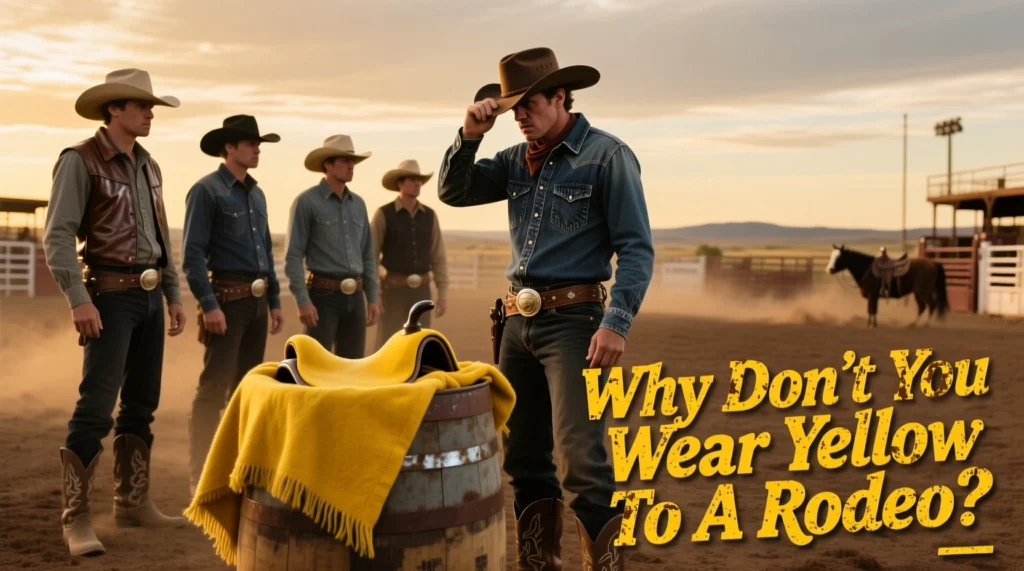
Why Don’t You Wear Yellow To A Rodeo? In rodeo culture, wearing yellow is considered a symbol of bad luck and cowardice.
You don’t wear yellow to a rodeo because, in cowboy tradition, yellow is the color of cowardice – the “yellow-bellied” coward of the Old West. In a sport built on courage, competitors historically avoided wearing the one color that publicly signaled fear.
That’s the short version, and it’s the origin most people mean. But the fuller answer is more interesting: the superstition has two documented origin stories, it has no basis in how animals actually behave, and today it’s followed by some riders, mocked by others, and treated by most as a piece of Western folklore rather than a real rule. Whether you’re a spectator or a competitor, nothing bad will happen if you wear yellow – you’ll just get some knowing looks from people who know the tradition.
- Wearing yellow to a rodeo is an old superstition tied to the color meaning cowardice – the “yellow-bellied” coward of frontier slang.
- There are two competing origin stories, not one: the cowardice etymology, and a theory that bullfighters wore yellow to attract bulls, making it a “dangerous” color.
- It has no effect on the animals. Cattle are red-green colorblind and react to movement, not color. This is entirely about rider psychology and tradition.
- Many top competitors ignore it. The superstition is well known but far from universally followed – several world champions reject it outright.
- The famous Four Sixes Ranch is often cited as banning yellow for staff and competitors.
- It’s one of a family of rodeo superstitions alongside no hats on beds, no chicken on competition day, and no change in your pocket.
Table of Contents
The Main Reason: Yellow Means Cowardice
The explanation of the dominant is about language, not luck.
The term “yellow belly,” meaning coward, was common American frontier slang, and old variants like “lily liver” carry the same meaning – liver was historically associated with courage, so a pale or “pale” liver meant a lack of it. In a culture where a cowboy’s reputation depended on visible nerve, wearing a color that literally means “coward” was asking for judgment.
That’s why taboo is especially associated with the field. It was never really about luck in the mystical sense. It was about not going into a contest of courage wearing the uniform of cowardice. Some cowboys took it so far that they wouldn’t own anything, in or out of the contest.
Two Origin Theories for the Yellow Taboo
How often each explanation appears across documented cowboy-superstition sources.
The cowardice etymology is by far the most cited. The bullfighter theory is documented but less common. Trail-drive and Civil War origins circulate online but lack reliable sourcing, so we exclude them. The origin is genuinely debated.
Rodeo Superstitions (and Why Yellow is Out)
- Yellow = Cowardice: The main reason is the old saying that associates yellow with fear. It is considered bad luck for a competitor to wear it.
- Chicken: Do not eat chicken before competing, as this means you will “chicken out” or act like a chicken.
- Hats: Never wear a cowboy hat to bed, as it is thought to bring injury or death.
- Empty pockets: Avoid competing with change in your pocket; otherwise, you can only win that much money.
- Shaving Before a Run: Some believe that shaving on the day of the competition cleans you up for “lady looks.”
- Common Bad Luck: Many competitors and fans believe that wearing the color on the field invites bad luck during a performance.
- Strict Traditions: Some popular Western establishments, such as Four Sixes Ranch, strictly prohibit staff and competitors from wearing yellow.
- No loose change: Competing with the change in your pocket is avoided because of the belief that pocket change will win you the day.
The Second Origin Story: The Bullfighter Theory
Here’s what most articles on the subject have to say: there is a competing origin theory, and honest folklore reporting includes it.
This version traces the taboo back to the early days of rodeo, when bullfighters – athletes who protect fallen riders, historically overlapping with rodeo clowns – are said to have worn bright yellow to distract the bull from the downed cowboy. In this narrative, yellow became a color associated with danger and provocation: you don’t wear the color that makes the bull charge you.
Both theories are documented in cowboy culture sources, and they are not mutually exclusive – a color can pick up meaning from more than one place. The intellectually honest answer is that the origin is debated, with both citing more than one analogy to cowardice.
(A note on accuracy: Some versions of the superstition claim that this trail drive connects to “warning flags” or Civil War history. We have found no reliable source for these specific claims, so we do not repeat them as fact.)
Does Yellow Actually Affect the Animals? No
This is the part that matters for the intent of the search, because many people assume that superstition has a practical basis in bull behavior. It doesn’t.
Cattle are red-green color blind. They are dichromats, meaning they see blue and yellow but can’t distinguish red from green like humans. More importantly, bulls in the arena react to movement, not color – the flapping of the cape, the movement of the rider, the flag. This is why the “red cape provokes the bull” idea from Spanish bullfighting is also a myth: it’s the movement of the muleta, not its color, that provokes the charge.
So a yellow rider is no more at risk from the animal than a blue rider. Whatever power there is in superstition is entirely psychological – it resides in the rider’s head, not in the bull’s eyes. It’s nothing; sports psychology is full of evidence that confidence and routine affect performance. But that means the color yellow is only unlucky for those who believe it is.
Does the Color Actually Affect the Animal?
What a rodeo bull actually reacts to, by influence on its behavior.
Cattle are red-green colorblind and respond to motion, not color – the same reason the “red cape enrages the bull” idea is a myth. The yellow superstition has no basis in animal behavior; it is entirely about rider psychology.
Do Bulls Even See Yellow?
How cattle perceive color compared with humans. Cattle are dichromats.
Cattle see blues and greens but cannot distinguish red or yellow the way humans do. A bull charges at motion, not color — which is why the yellow taboo is about human psychology, not the animal.
Rodeo Superstitions: Yellow Is One of Many
The taboo on yellow belongs to a whole family of cowboy superstitions, most of which date back decades to rodeo culture. Understanding others shows that yellow is not something strange – it fits a pattern.
| Superstition | The reasoning behind it |
|---|---|
| Never wear yellow in the arena | Yellow means cowardice (“yellow-bellied“); some also cite the bullfighter-attracts-bulls theory |
| Never set a cowboy hat on a bed | Associated with death (the “eternal sleep“) and, practically, with spreading head lice in the days of monthly bathing; said to bring injury or death |
| Don’t eat chicken on competition day | “You are what you eat” – eating chicken means you’ll “chicken out“ |
| No change in your pocket while competing | The belief that pocket change is “all the money you’ll win” that day |
| Always shave before a performance | Cleaning yourself up for “Lady Luck,” who is said to favor a clean shave |
| Don’t use brand-new tack or gear | New equipment in a rodeo is considered unlucky |
| Cowgirls wear mismatched socks | A good-luck ritual, the inverse of the avoidance superstitions |
| Never kick a paper cup in the arena | Bad luck – and practically, a blowing cup can spook a horse |
Read together, these are not random. They are a pre-performance routine – a way to control nerves before a dangerous, unpredictable eight seconds. This is the real work of rodeo superstition, and it is the reason why baseball players do not step on the wrong line.
The Rodeo Superstition Family
How feared each common rodeo superstition is, relative to one another.
Relative ranking based on how consistently each superstition appears across documented cowboy-culture sources. The hat-on-a-bed taboo – tied to death and, practically, head lice -is universally cited as the strongest.
The Hat-on-the-Bed Story: A Real Example
The most powerful of all rodeo superstitions isn’t yellow – it’s the hat on the bed, and there’s a real documented example of one.
At the 2009 National Finals Rodeo, steer wrestler Hunter Cure’s hat was inadvertently placed on the bed in his Las Vegas hotel room by a family member, in the middle of his first NFR. As he told the Las Vegas Review-Journal, his “jaw dropped” when he saw it. He’s not otherwise superstitious — he’s said he couldn’t care less about Friday the 13th – but the hat-on-bed ban is so strong that even skeptics feel it. Cure won the World Steer Wrestling title in 2013, so the “curse” clearly didn’t stick.
The story explains why these traditions survive: they are memorable, they are social, and they give competitors something to control in a game where much of the outcome is out of their hands.
What Real Cowboys Actually Say About Yellow
The most honest thing about this superstition is how many top competitors openly reject it – and their real, on-the-record reasons are far more interesting than the invented quotes that circulate online.
Steer wrestler Matt Reeves, a world title contender, gave the Las Vegas Review-Journal the ultimate: He doesn’t wear yellow, but not out of superstition. In his words, he thinks he looks like a big bird in it – a practical style objection that has been framed as tradition. The quote captures the modern attitude perfectly: The rule lives on, but half the people who follow it are doing so for reasons that have nothing to do with luck.
Broadly speaking, today’s riders fall into three camps:
- Traditionalists who follow the old rules as part of a pre-competition routine that steadies the mind.
- Pragmatists who avoid yellow but for practical or stylistic reasons – like Reeves – rather than genuine belief.
- Skeptics who reject superstition entirely and sometimes break the rules deliberately, setting hats on beds to needle their more superstitious travel partners.
Most professionals, if pressed, land somewhere in the middle: they know the tradition, they half-follow it, and they don’t really believe that the color of the shirt decides the ride.
Rodeo’s Colors: Meaning at a Glance
How the sport’s unwritten color code is generally read.
None of this is written in any rule book — it is an unwritten cultural code. Yellow is the one color carrying negative baggage; red is its symbolic opposite.
The Color Language of Rodeo: Beyond Yellow
If yellow is a color to avoid, the flip side is that rodeo has a whole visual vocabulary of color-a useful “non-commodity” angle that most articles miss.
Red has strong positive associations in Western attire: passion, power, intensity. Brands like PRCA and Wrangler use red prominently, and it reads as confidence rather than cowardice. Black signals classic, unabashed authority – the traditional “good guy in the black hat” upside down. Blues and denim are the neutral working base of cowboy dress, blending into any arena.
The point is, what a rider or fan wears is a kind of signaling. Choosing your colors at rodeo – leaning toward red, steering clear of yellow – is a quiet way to show that you understand the culture’s unwritten code. It’s true whether you believe in a thread of superstition or not.
Case Study: Why the Superstition Refuses to Die
Avoiding yellow is a useful case study in how sports superstitions persist even when everyone knows they’re literally not true.
Consider the facts that work against superstition: Animals can’t be affected by it (color blindness and reaction based on movement), the origin is debated rather than proven, and many of the biggest names in the sport openly ignore it. By any rational measure, it should have died out decades ago.
It didn’t happen for three reasons. First, it’s low-cost: It’s easy to avoid a color, so there’s no real harm in making it funny. Second, it’s social: It’s a shared piece of insider knowledge that marks who belongs to rodeo culture and who doesn’t. Third, it’s psychological: In a sport where a rider could literally get injured in the next eight seconds, any ritual that provides a sense of control is valuable, regardless of whether it “works.”
This is the profound answer to why you don’t wear yellow to rodeo. Not because yellow is dangerous – but because superstition works in ways that have nothing to do with the color.
The Future of Rodeo Wear
Yellow is taboo folklore, but rodeo attire itself is changing rapidly, and that’s a forward angle worth knowing.
- Performance fabrics – moisture-wicking, four-way stretch Western shirts – are replacing the tradition of pure cotton and beaded imagery at the competitive level.
- Protective equipment is increasingly becoming the standard: certified safety vests in bull riding, and the slow, competitive increase in helmet use among younger riders, replacing felt hats for some.
- Sponsorship branding now dictates what most riders wear, and the sponsor’s color often overrides personal superstition – if your sponsor’s logo is yellow, tradition is over.
- Fashion crossover has pulled Western clothing into the mainstream, and there is no prohibition on yellow in mainstream fashion, which is gradually relaxing the rule among younger and non-competitive wearers.
Possible trajectory: The yellow superstition lives on as a story – a fun piece of heritage fans enjoy – while what the athletes actually wear matters less. Tradition becomes trivial.
Final Thoughts
You don’t wear yellow to rodeo because tradition says that yellow is the color of cowardice – the “yellow-bellied” coward – and no competitor wants to give a hint of fear in a sport built on nerves. Another, older theory links it to bullfighters who wear yellow to attract bulls. The origin is genuinely debated.
What’s not debated: It has no effect on the animals, who are color-blind and react to movement, not color. The whole superstition lives in the human psyche, which is why it survives despite everyone knowing that it’s not literally true. Wear yellow if you want to – you’ll be perfectly safe, and you’ll have a great conversation starter about one of the most enduring pieces of rodeo folklore.
Frequently Asked Questions For Why Don’t You Wear Yellow To A Rodeo?
Is it really bad luck to wear yellow to a rodeo?
According to a long-standing rodeo superstition, it is considered bad luck. Whether it causes bad luck is a matter of personal belief. For many competitors, it is a tradition they follow to maintain a competitive mindset.
Does yellow really affect bull behavior?
No evidence; bulls are color blind, reacting to movement. This is pure rider psychology.
Where did this superstition come from?
It originates from the old American slang term “yellow-bellied,” meaning coward. This association dates back to frontier days and is embedded in rodeo culture, where showing courage is paramount.
What colors are safe for rodeo attire?
Blues, reds, blacks – neutral tones blend in arenas.
Do all cowboys and cowgirls follow this rule today?
No, the ban varies widely. Although the superstition is known worldwide, many modern athletes, including world champions, do not strictly adhere to it. Some avoid yellow for practical or stylistic reasons, while others ignore it altogether.
Are rodeo superstitions still common?
Yes, 70% of PBR professionals follow them per poll.
If yellow is bad, are there “good luck” colors to wear?
The color red is strongly associated with strength, confidence, and rodeo success. Additionally, some cowgirls believe that wearing mismatched socks brings good luck.
As a spectator, should I avoid wearing yellow?
As a fan, you are generally free to wear whatever you like. However, wearing yellow may earn you some knowing smiles or comments from rodeo insiders who recognize the old superstition. It can be a fun conversation starter about the sport’s rich traditions.
How do rodeo penalties work?
Touching with hands or rushing will result in reduced scores or disqualification.
Where did the “don’t wear yellow” superstition come from?
There are two documented origin stories. The most prominent is the frontier slang “yellow-bellied,” meaning coward. The second traces its origins to early rodeo bullfighters who wore yellow to attract bulls, associating the color with danger. The origin is debated.
Do bulls hate the color yellow – or red?
Neither. The idea that bulls are angry at any color is a myth. Cattle are red-green color blind and respond to the cape, flag, or movement of the rider, not its color. This also applies to the myth of the Spanish bullfighting “red cape.”
What colors should you wear to a rodeo instead?
Reds, blues, denim, black and neutral earth tones are all traditional and safe. The color red, especially in Western clothing, has positive associations of strength and confidence.
As a spectator, should I avoid wearing yellow to a rodeo?
You don’t have to. As a fan you can wear whatever you want – nothing will matter. You might get some knowing smiles from rodeo insiders who recognize the old superstition, which makes it a fun conversation starter.
Do professional cowboys still follow the yellow superstition?
Some do, many don’t. It’s widely known but far from universally followed. Some avoid yellow out of genuine tradition, others for practical or stylistic reasons, and many world champions reject it altogether.
What is the Four Sixes Ranch yellow rule?
The historic Four Sixes (6666) Ranch in Texas is frequently cited in cowboy culture sources as prohibiting yellow for crew and competitors – a famous institutional example of superstition.
What are the other main rodeo superstitions?
Never wear a cowboy hat to bed (associated with injury or death), don’t eat chicken on the day of a competition (you’ll “chicken out“), don’t compete with your pocket change (you’ll win it all), always shave before competing (for ladylike looks), and don’t use brand new gear.
Why is putting a hat on a bed considered worse than wearing yellow?
The prohibition of hats in bed is the strongest rodeo superstition, linked to death (“eternal sleep“) and the spread of head lice during the practically monthly bathing period. It is said to bring injury or even death, which is far more feared than the color of a shirt.
Is there any science behind rodeo superstitions?
Not literally – but sports psychology supports the idea that pre-performance routines and a sense of control can calm nerves and help focus. That’s exactly what these superstitions do in a dangerous, unpredictable sport.
What does “yellow-bellied” mean and where did it come from?
This is American frontier slang for a coward. It is related to older terms such as “lily leeward,” based on the historical belief that the liver was the center of courage – a pale or “pale” liver meaning a lack of bravery.
Did cowboys really refuse to own anything yellow?
Some did. According to cowboy culture sources, the most committed followers of the superstition avoid the color yellow completely, refusing to buy yellow clothing for any part of their wardrobe – not just on the field.
Is wearing yellow banned by the PRCA or any rodeo rules?
No, it’s purely folklore and personal preference. No sanctioning body – PRCA, WPRA or otherwise – has any rules about superstitious clothing colors. Official dress codes are about things like long sleeves and cowboy hats, not luck.
Sources & Reference
- Las Vegas Review-Journal — Rodeo superstitions (Matt Reeves “Big Bird” quote; Hunter Cure hat story)
- Horsey Hooves — “10 Cowboy Superstitions Still Practiced Today”
- Yardbarker — “Top Cowboy Superstitions You Should Know” (bullfighter origin theory)
- My Life As A Rodeo Mom — “Rodeo Superstitions” (yellow-bellied origin)
- Saddle Up Magazine — “Rodeo Superstitions” (cowardice/liver folklore)
- Double D Ranch — “Debunkin’ Style Superstitions” (Pecos 1883 origin)
- Galaxy Press — “Superstitions of the Old West”
- Fort Worth Magazine — “Cowboy Hat Folklore, Superstitions, and Etiquette”
- American Cowboy — “Lost Skills of Cowboy Superstitions”
- Saddle Up Colorado — “Cowboy Superstitions” (Four Sixes Ranch yellow ban)
- Professional Rodeo Cowboys Association (PRCA)
- Women’s Professional Rodeo Association (WPRA)