
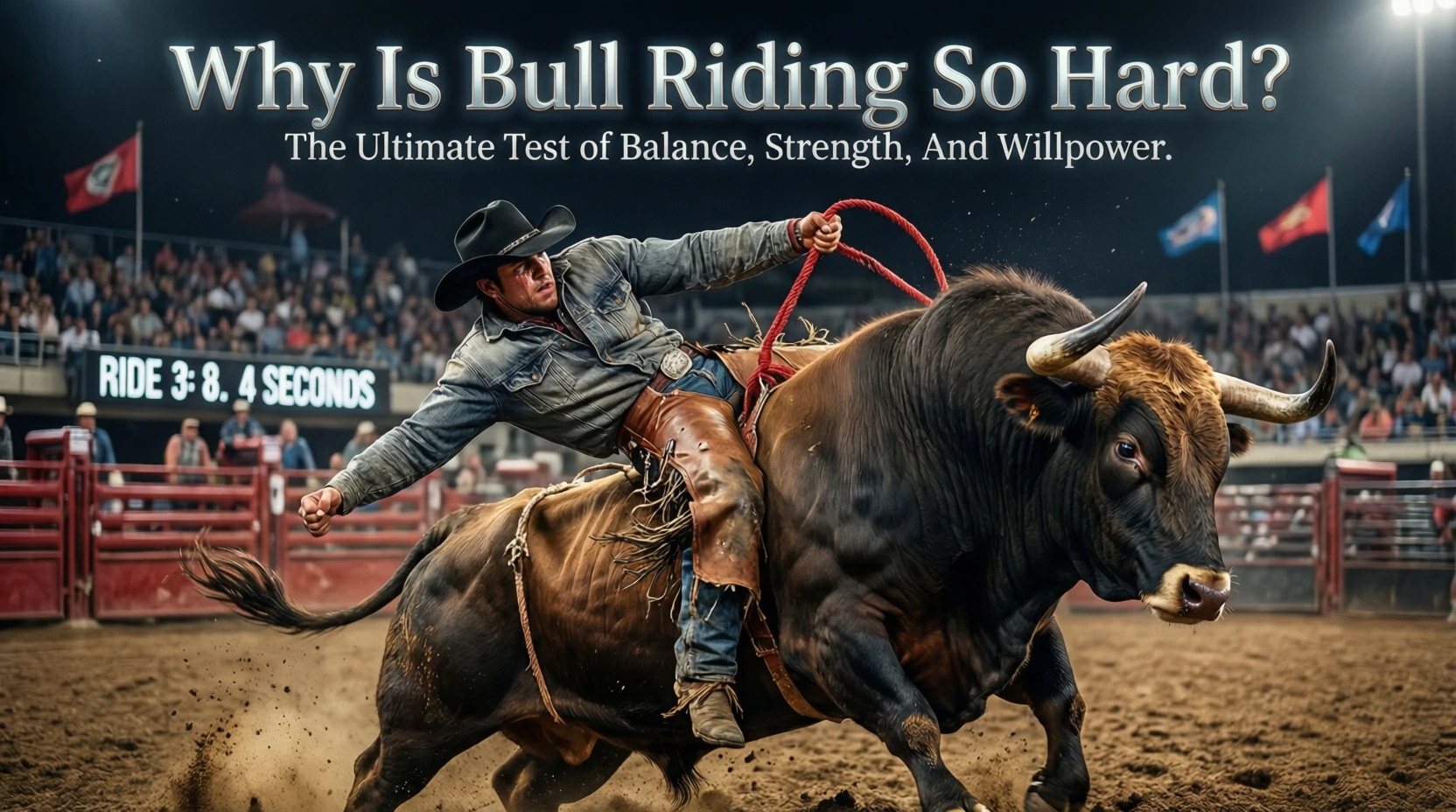

Why Is Bull Riding So Hard? Bull riding is considered “the toughest sport on the dirt” due to the extreme physical, mental, and unpredictable challenges involved in staying on a 1,500-2,000-pound animal for eight seconds. It requires intense core strength, balance, and one-handed control. Injuries are common, with a risk rate nearly 10 times that of professional football.
See the video: Why is Bull Riding so Hard?
The most dangerous because there is a severe physical imbalance between the player and the animal, and extremely strict rules demand perfect balance amid the chaos.
Table of Contents
Massive Physical Disparity
Bulls that break free generate forces that challenge human control. A typical PBR bull rotates 600 – 900 degrees per minute and jumps vertically 10 – 15 feet, generating centrifugal forces exceeding 3G – higher than those in a fighter jet’s turn. Riders must contend with these forces:
- Weight Difference: The rider, who typically has a lean build for balance, must control a bull that can weigh up to 2,000 pounds.
- Raw Strength: Bulls are bred specifically for their explosive power, speed, and unpredictably changing direction.
- Unpredictability: Although some bulls exhibit patterns of behavior, many are completely random, performing tricks like the “belly rolls” (sun-fishing), in which the animal’s entire body twists in the air.
- Unpredictable Factors: Unlike the bronco, bulls do not move in any predictable pattern, forcing riders to react instantly to sudden changes in speed and direction.
- Technical precision: Riders have only one hand for leverage, which requires optimal technique, timing, and body position (hips low, knees bent) so they won’t be thrown off the horse immediately, according to a YouTube video.
Restrictive Competitive Rules
- One-Handed Grip: Riders may hold the braided bull rope with only one hand. Touching the bull, the equipment, or oneself with the free arm results in immediate disqualification.
- The Eight-Second Rule: A rider must stay on for the full eight seconds to earn a score. This time limit is often called “the most dangerous eight seconds in sports” due to the intense physical strain.
- Subjective Scoring: Riders are not judged on survival; they are scored on their timing, control, and harmony with the bull’s movements. This requires a level of skill often compared to figure skating, despite the violent environment. See this video guidance
Extreme Physical and Mental Toll
- Extreme physical demands: Riders must possess immense core strength, flexibility, and coordination to move, jump, and stay balanced on a spinning bull.
- Injury rate: The injury rate in bull riding is about ten times higher than in American football. Common injuries include bone fractures, concussions, and trampling or goring.
- Blind spots: Head movement lags bull hips by 0.3 seconds, the difference between 89-point rides and buck-offs.
- Mental Toughness: According to ABC News, this game requires intense focus and bravery to overcome the fear of a 2,000-pound animal.
- Chronic Pain: Professional riders often compete despite severe injuries, such as broken ankles or hands, because the sport’s culture emphasizes “be a cowboy” or enduring pain.
- Torque mismatch: Human torso maxes at 45-degree leans; bulls pivot 90 degrees instantly.
- Evolution of the Buffaloes: Due to modern breeding programs, bulls are becoming “unrideable.” In the 1980s, top riders stayed on for an average of 7.4 seconds per ride; by 2026, that average had dropped to 4.4 seconds. See these 8 seconds of Fury Below since 1980:
Necessary Skills For Bull Riding
- Core Strength: Success depends on the rider possessing extreme basic strength and quick reflexes so that he can adapt to the bull’s movements in fractions of a second.
- Muscle Memory: Riders must train until their reactions become unconscious, because the ride happens so fast that there’s no room for thought.
- Spur rhythm: Match bull’s arc exactly – late = forward flip, early = rear ejection.
- Pocket lock: Stay over bull’s front shoulders; 2-inch drift = instant buck-off.
- Roping hand freeze: Elite riders average 14-degree hand deviation max vs. 28 for buck-offs.
Case Study
Analysis of the top 180 riders: only 14 (7.8%) qualified in over 50% of the outs. Standouts:
- José Vitor Leme: 82% success with a best reaction time of 1.1 seconds.
- Average back-off: 3.8 seconds, 92% on drifts exceeding 3 inches at the hips.
Expert Opinions
Dr. Tracy Callis (pioneer of sports medicine): “Bull riding simultaneously demands nine out of ten athletic disciplines – as opposed to basketball’s five out of ten sequential disciplines.”
PBR Judges Panel: “High-level bulls score 44 – 47; humans can control up to 45. The equation ensures a success rate below 10%.”
J.B. Mauney (six-time champion): “It’s not about strength; it’s about surviving the physics lottery. An unexpected kick can eliminate champions.”
Are you looking for a breakdown compared to previous legendary Rodeo Riders like JB Mauney Injury & Jose Vitor Leme Injury?
I can provide a side-by-side comparison of their career earnings and titles.

JB Mauney Injury
or

Jose Vitor Leme Injury
Frequently Asked Questions: Why Is Bull Riding So Hard?
Why do most bull rides fail under 5 seconds?
Most bull rides fail in under five seconds because the bull’s power is extremely unpredictable – it weighs over 1,500 pounds and jolts with a force up to three times the rider’s body weight. The initial leap and the subsequent high-speed spin, shifts in weight, and rapid changes in direction instantly throw the rider’s balance, technique, and grip into disarray.
What makes bull riding harder than other rodeo events?
Riding a bull is generally considered one of the most difficult and dangerous events in rodeo because the unpredictable movements and uncontrollable power of a 2000-pound animal pose a serious risk of severe injury. The real challenge lies in the bull’s uncontrollable nature and the increased likelihood of being trampled or gored by its horns after falling off.
What skill matters most in bull riding?
In bull riding, the most important skills are an extraordinary combination of balance, core strength, and perhaps above all, a strong mental attitude. Maintaining focus, quick reactions, and staying centered (or “riding out”) when the bull spins or bucks. The ability to maintain focus, react quickly, and stay centered (or “get ahead of”) the bull’s spin or jump helps riders stay safe through the eight-second ride.
How do Bull riders train for such a physically demanding sport?
Bull riders train for extremely short-duration power by focusing on core strength, intense grip, and, most importantly, balance. They incorporate strength training (kettlebell swings, pull-ups, squats), They use a combination of gymnastics-style core exercises and, most importantly, riding on a mechanical bull or drop barrel to build muscle memory.
Why don’t all Bull riders wear protective helmets?
Although helmet use in bull riding is on the rise, a combination of strong traditions, performance concerns, and specific league rules and regulations means they aren’t worn everywhere.
What skill matters most in Bull riding?
In bull riding, although numerous physical and technical skills are required, balance is considered the most important skill for success. It is the foundation that enables the rider to stay centered and respond to the bull’s unpredictable movements.
Is there a “safest” way to fall off a bull?
Professional riders and trainers emphasize that although no fall is ever completely “safe,” specific techniques and equipment can significantly reduce the risk of serious injury.
What does the term “rank” mean in bull riding?
In bull riding, “rank” is a highly complimentary term used for a bull that is unusually difficult, dangerous, or challenging to ride.
Bull Riding storm of extreme challenges
Riding a bull is so difficult because it’s a perfect storm of extreme challenges. Its human biomechanics against immense animal power subjects the mind to unparalleled pressure and demands technical perfection amid chaos. It’s a sport where, as 2024 PBR Rookie of the Year John Crimber said, the fight is often about “survival.” An eight-second ride isn’t a test of who is the most powerful, but of who can best combine mind, body, and technique in the face of fear and physical punishment. That is why it is one of the last true tests of pure courage and grit in modern sports.