
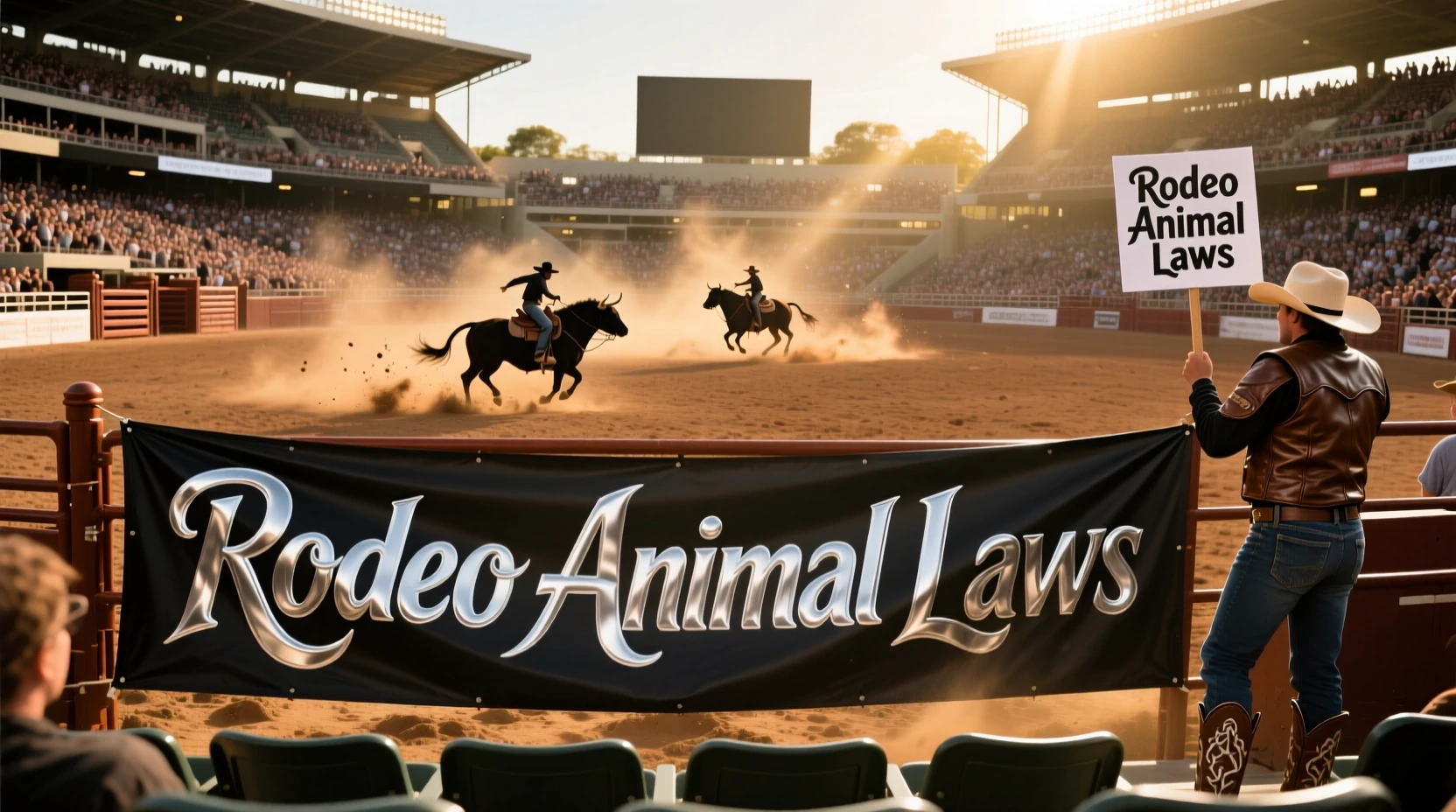

Rodeo animal laws in the United States vary significantly by jurisdiction, as there is no specific federal law governing the welfare of rodeo animals. Instead, regulations are a patchwork of federal transportation laws, state laws, and municipal ordinances.
Rodeo animal welfare in the United States is governed by a patchwork of state and local laws, as no federal law specifically protects rodeo animals. The federal Animal Welfare Act – the U.S.’s main animal protection law – does not cover animals used in rodeos, so protection depends entirely on where the rodeo takes place.
This creates three tiers. At the federal level, there are essentially no rodeo-specific protections. At the state level, the picture ranges from Rhode Island to 17 states, which devote an entire chapter of law to rodeo animals, exempting rodeos from their cruelty laws entirely. At the local level, dozens of cities and counties have added their own rules – some banning specific equipment, some banning rodeos altogether. At the top is the PRCA industry self-regulation, which is a private rulebook, not a law.
- There is no federal law that specifically protects rodeo animals. The Animal Welfare Act does not cover them, so this regulation falls to states and cities.
- The result is a patchwork. Laws vary greatly by jurisdiction – from Rhode Island’s comprehensive rodeo chapter to states that exempt rodeos from cruelty laws entirely.
- 17 states exempt rodeos: Their anti-cruelty laws provide no state protection for animals.
- 13 states ban horse tripping, the fastest-growing category of rodeo animal law.
- Rhode Island is the only state Banning traditional calf roping and steer roping, only allowing separate roping.
- California (Penal Code §596.7) has the most detailed statewide rule, Requires a veterinarian, 48-hour injury reporting, and limitations on electric products.
- The PRCA self-regulates With about 60 welfare laws – but these are private industry standards, not law, and only apply to sanctioned rodeos (about 30% of American rodeos).
Table of Contents
How Is Rodeo Animal Law Structured?
Rodeo animal regulation operates on four levels that interact:
| Level | Who sets it | Legal force |
|---|---|---|
| Federal | US Congress / USDA | At a minimum, rodeo animals are outside the Animal Welfare Act. |
| State | State legislatures | Binding law; varies enormously by state |
| Local | Cities and counties | Binding within that jurisdiction; often stricter than the state |
| Industry | PRCA, PBR, WPRA | Private Rules – Enforceable only as event contracts, not public law. |
Three Layers of Rodeo Animal Law
Relative strength of protection by level of government, generalized.
Protection increases as you move down levels of government. Cities have passed the strictest rules; federal law provides virtually none. Source: Michigan State University Animal Legal & Historical Center.
The Four Levels of Rodeo Animal Regulation
How much enforceable protection each level actually provides.
Federal law provides almost no rodeo-specific protection. Local ordinances are frequently the strictest. PRCA rules are detailed but private and cover only sanctioned rodeos — about 30% of the US total.
Federal Law: Why There’s Almost No Protection
This is the single most important fact about rodeo animal law, and the one that most people get wrong.
The Animal Welfare Act (AWA) does not protect rodeo animals. It is often said that the AWA “exempts rodeos,” but the more obvious legal fact is that the animals used in rodeos – cattle and horses, which are classified as livestock – are outside the AWA’s definition of a covered animal in this context. The effect is the same: the basic federal animal protection law provides no meaningful coverage for rodeo livestock.
One federal law that is sometimes cited is the Twenty-Eight Hour Law, which requires that animals transported across state lines by certain carriers be taken off the road after 28 hours for rest, food, and water. But it was written for commercial livestock transportation, has exceptions, and is not a rodeo welfare law in any practical sense. It does not regulate what happens inside the arena.
The bottom line at the federal level: There are no national standards for how rodeo animals can be treated during competition. State and local laws are very important because of this gap.
How States Treat Rodeo Animals
How US states treat rodeo animals under their anti-cruelty statutes.
More states exempt rodeos from cruelty law than protect the animals in them. Horse-tripping bans are the fastest-growing measure. Source: Animal Legal & Historical Center; California Penal Code §596.7.
State Law: A Patchwork From Strong to Nonexistent
State law is where rodeo animal regulation actually lives, and it spans the full spectrum.
The states that exempt rodeos entirely
According to the Animal Legal and Historical Center, more states exempt rodeos from anti-cruelty laws than protect them. Seventeen states exempt rodeos entirely from their cruelty laws, with no alternative coverage provided – the same practical result as the federal AWA. Others only exempt “rodeo practices that are currently acceptable to the Professional Rodeo Association,” effectively writing the PRCA’s private rules into state law.
Rhode Island: the strongest state law
Rhode Island is a clear outlier. Its general statutes have an entire chapter, Title 4, Chapter 20, “Rodeo Animals and Livestock,” devoted to the subject. Under that statute, Rhode Island:
- It is the only state to ban traditional calf roping, allowing only separate roping where the calf is released immediately without a sudden stop or fall.
- It is the only state to ban steer roping (a consequence of the same ban).
- Requires promoters to notify the local animal control officer in writing of the date and time of any rodeo.
- Requires a licensed large animal veterinarian with at least two years of experience, at the promoter’s expense.
- Bans any person found guilty of animal cruelty from participating in future rodeos.
California: the most detailed statewide rule
California Penal Code §596.7, adopted in 2000, is the most comprehensive statewide operational rule. It requires rodeo management to:
- Ensure that a licensed veterinarian is present, or on call and available within one hour of injury determination.
- Grant this veterinarian full access to the scene of any incident and the authority to disqualify any animal for good cause.
- Ensure that injured animals are examined and treated promptly.
- Have a conveyance available at all times to humanely remove injured animals.
- Ensure that no electrical equipment is used when an animal is in a holding injury, except to protect people.
California Rodeo Injury Reports: The Data Gap
Outcomes in injury reports reviewed for the Los Angeles ordinance.
In 14 of the reviewed reports, the animal’s fate was left unclear — because the veterinarian was denied access or the report omitted the outcome. That reporting gap, not any single incident, drives much current legislation. Source: LA City Council record / LA Times review.
Importantly, attending veterinarians in California are also required to report any animal injury that requires treatment to the state Veterinary Medical Board within 48 hours of the rodeo – one of the only public injury reporting mandates in the country. Violations carry fines ranging from $500 to $2,000 for a first offense and up to $5,000 for a repeat offense.
Horse tripping: the fastest-growing category
The single most active area of state rodeo law is the ban on horse tripping – the act of chasing a horse and lashing its legs to bring it down. Thirteen states have banned horse tripping, according to the Animal Legal and Historical Center, and the ban is being passed faster than any other form of rodeo animal protection. The states include Arizona, California, Florida, Illinois, Kansas, Maine, Nebraska, Nevada, New Mexico, Oklahoma, Oregon, Texas, and Virginia.
Local and Municipal Ordinances
Cities and counties frequently go further than their states, and this is where outright rodeo bans appear.
| Jurisdiction | Restriction |
|---|---|
| Baltimore, MD | Prohibits the use of spurs in rodeos |
| St. Charles, IL | Prohibits electric prods once an animal is in the holding chute |
| Pittsburgh, PA | Early ban on traumatic devices – electrical products, sharp spurs, specific flank straps |
| Chino Hills, Irvine, Laguna Woods, Pasadena (CA) | Ban rodeos altogether |
| Napa County, CA | Prohibits rodeos |
| Fort Wayne, IN | Prohibits rodeos |
| St. Petersburg, FL | Prohibits rodeos |
| Greenburgh, NY | Prohibits rodeos on town property |
| San Juan Capistrano, CA | Requires human conveyance; restricts calf weight; bans jerk-downs |
| Alameda & Contra Costa Counties, CA | Ban steer tailing/tripping |
Internationally, the contrast is clear: the UK has banned rodeos altogether, Germany and Vancouver have banned calf roping, and parts of Australia and New Zealand restrict or prohibit rodeo events.
Industry Self-Regulation: The PRCA Rule Book
Rodeo is the largest body of animal laws in the country, along with public law – and it’s not a law at all.
The Professional Rodeo Cowboys Association (PRCA) maintains about 60 animal welfare rules for its sanctioned events. They require an on-site veterinarian, pre-competition inspections of animals, fleece- or neoprene-lined flank straps, dull-free rolling spur reins, limits on electrical products, and penalties for mistreatment. The PRCA reports an injury rate of about 0.04% – less than one in 2,000 – based on its veterinary surveys.
Two limits are essential to understand:
- These are private rules, not public law. They are binding on PRCA members as a condition of competing, but a non-member or unsanctioned rodeo is not covered by them.
- The PRCA only regulates 30% of US rodeos. The other 70% are governed by other associations’ rules or not at all. So the PRCA rulebook, while detailed, governs a minority of rodeos actually held.
History: How Rodeo Animal Law Developed
Rodeo animal regulation has been in the making for over a century, and knowing the timeline explains what the law looks like.
| Era | Development |
|---|---|
| Late 1800s – early 1900s | Organized opposition to the treatment of animals in public spectacles begins. Early humanist movements form. |
| 1906 | The Twenty-Eight Hour Law is enacted, regulating interstate livestock transport |
| 1966 | Federal Animal Welfare Act passes – but it doesn’t include farm and rodeo livestock. |
| 1980s | Rhode Island enacts its dedicated rodeo chapter (1988 – 89), the first comprehensive state rodeo law |
| 2000 | California adopts Penal Code §596.7, the most detailed statewide operational rule |
| 2000s – 2010s | Horse-tripping bans spread rapidly across states |
| 2020s | City-level device bans and outright rodeo bans expand; injury-reporting and veterinary-authority requirements grow |
The pattern is consistent: Because the federal government stepped back, reforms have occurred city by city and state by state, which is why the map is a patchwork.
Most-Regulated Rodeo Practices
How widely each practice is restricted across US jurisdictions.
Horse tripping is the single most-regulated rodeo practice and the fastest-growing category of new law. Source: MSU Animal Legal & Historical Center; SHARK ordinance list.
Case Study: California’s Injury-Reporting Experiment
California’s §596.7 is the closest thing America has to a natural experiment in rodeo transparency, making it a useful case study.
By requiring veterinarians to report every treated injury to the state board within 48 hours, California created the only meaningful public data set on rodeo animal injuries in the country. In principle, this should settle the factual debate about how often animals suffer. In practice, this has exposed the difficulty of enforcement: advocates, including SHARK, have blamed underreporting and gaps in compliance, while the PRCA points to its audited low injury rates.
This lesson is instructive for anyone following rodeo law moving forward. The fight has shifted from whether rules should exist to whether they are enforced and whether data is public. California shows that a reporting mandate is only as good as its compliance, and transparency – not just the rules – is becoming a central battleground.
Expert and Advocacy Positions
On a controversial legal topic, the honest approach is to present the actual positions of the key parties rather than a single decision.
- The PRCA maintains that its veterinary surveys show a 99.9% injury-free rate in its nearly 355,000 annual animal shows, and that mandatory vetting, inspection, and equipment regulations make sanctioned rodeos safe. Its Animal Care and Welfare Committee, led by veterinarian Dr. Doug Corey, defends the self-regulation model.
- The American Veterinary Medical Association (AVMA) recommends that all rodeos follow humane treatment principles such as the PRCA’s, effectively endorsing the rulebook as a minimum standard beyond which rodeos have little meaning.
- The Animal Legal Defense Fund argues that the AWA’s exemptions leave a protection gap, that self-regulation is inadequate, and that states should end the cruelty law exemptions and mandate independent oversight.
- SHARK and other advocates focus on enforcement and transparency, alleging underreporting of public injury data and pushing for device bans.
The real disagreement is not about whether animals should be protected – it is about whether industry self-regulation is sufficient, or whether enforceable public law is needed.
The Future of Rodeo Animal Laws
The direction of travel is reasonably clear from the current trend lines.
- More horse tripping bans. 13 states have already been covered, and with the ban on tripping being passed faster than any other measure, more states are likely to follow.
- More injury reporting requirements modeled on California, shifting the battle to transparency and public data.
- More veterinary authority mandates – requiring doctors not only to be present but to give the final opinion on an animal’s fitness – as California and Rhode Island have already done.
- City-level action is underway, including device bans and, in a growing number of jurisdictions, bans on rodeos altogether – often with carve-outs for cultural traditions like the charreada.
- Pressure to close the AWA gap, as advocacy groups continue to argue for federal standards that would eliminate the patchwork
What is unlikely in the near future is a single federal rodeo-welfare law. The realistic future is more state and local law, more reporting, and a narrowing of the gap between the best-regulated jurisdictions and those with no protections.