
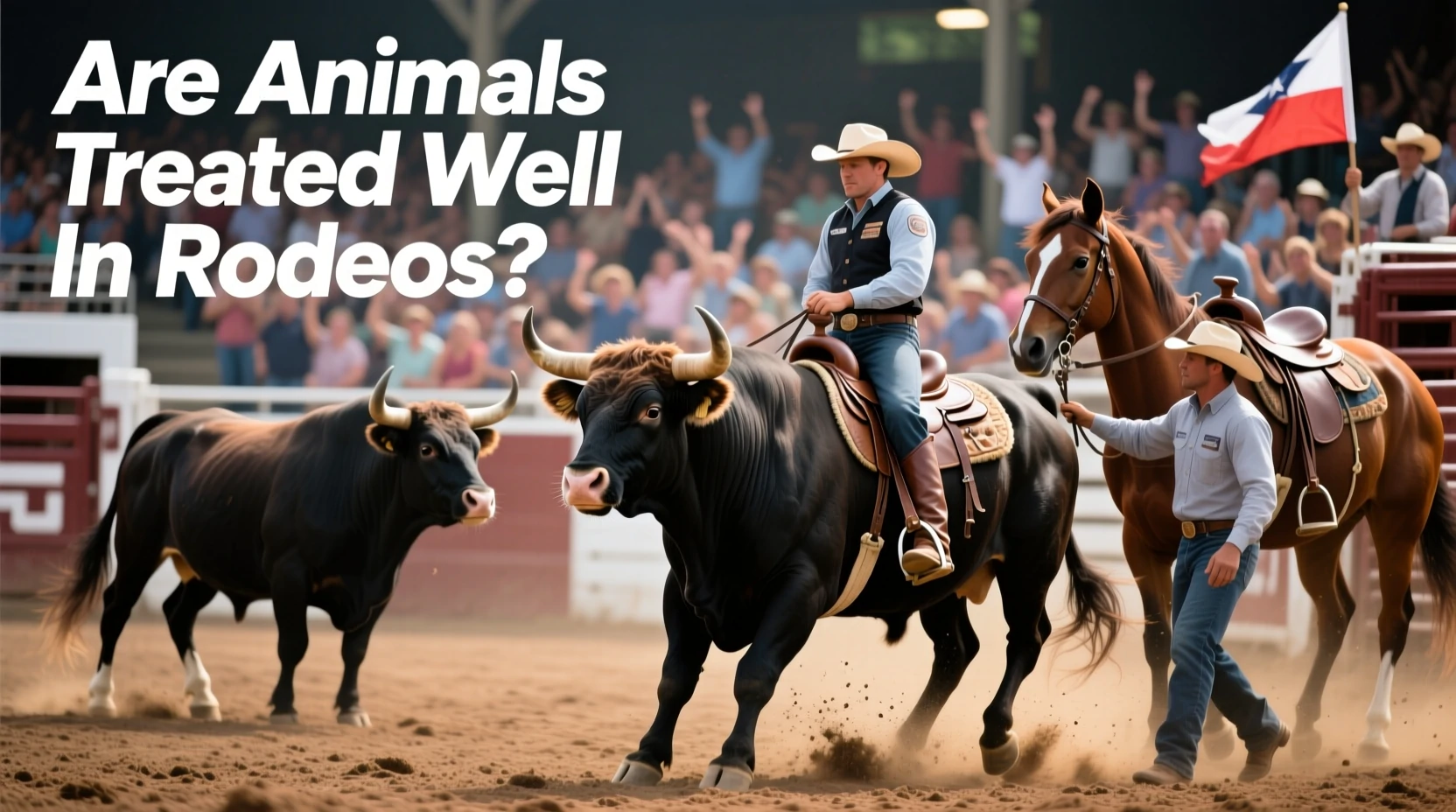

Are Animals Treated Well in Rodeos? Mostly yes at sanctioned rodeos, which have veterinarians on site and injury rates around 0.05%, but standards vary widely at 70% of PRCA sanctioned rodeos.
It depends on which rodeo you are talking about. At professionally sanctioned rodeos – especially PRCA events, which require an on-site veterinarian, pre – competition animal inspections, and roughly 60 livestock welfare rules – independent veterinary surveys have consistently measured arena injury rates between about 0.04% and 0.06% of animal exposures (roughly one injury per 2,000 runs), while a more recent industry review reported an injury rate closer to one in 1,000 runs.
However, the PRCA sanctions only about 30% of U.S. rodeos. Peer-reviewed research has documented fear and distress in calves during roping events, while several jurisdictions have restricted certain rodeo practices and animal welfare organizations argue that injuries are underreported and that unsanctioned rodeos often lack the same oversight. The most balanced conclusion is that well-regulated rodeos generally operate under much stronger animal welfare standards than critics often assume, while specific events and unsanctioned rodeos continue to raise legitimate welfare concerns supported by scientific research.
This guide separates three things that often get mixed together:
- What the rules of sanctioned rodeo actually require.
- What independent measurements and peer-reviewed studies show.
- What critics and the law say. Where the evidence is contested, we present both sides and say so. Every statistic is traceable to a named source listed at the end of this article.
Table of Contents
What “Treated Well” Actually Means in Rodeo
This question sits at the heart of one of the longest-running debates in American sports. Rodeo supporters point out that horses and bulls are expensive, carefully bred athletes – a top-notch bull can cost six figures – and that harming them would destroy sales for the stock contractors who produce them. Critics counter that welfare is not just about injuries: it’s also about fear, stress, and the ethics of using animals for entertainment.
Both framings are valid, which is why this article looks at four types of evidence: written welfare rules, measured injury rates, peer-reviewed behavioral research, and legal records. Together, they provide a much more complete answer than either side’s talking points.
How Sanctioned Rodeos Protect Animals: The Rules That Actually Exist
1. Mandatory On-Site Veterinarians
PRCA rules require that a veterinarian be present at every sanctioned performance and easement event. The on-site veterinarian examines livestock, provides immediate treatment to injuries, and takes a leadership role in the quality of care. PRCA rules also require that a large animal ambulance, trailer, sled, or similar transportation be on site so that an injured animal can be transported for evaluation and treatment – infrastructure that is not available at most unsanctioned events.
2. Pre-Competition Inspection of Every Animal
Animals are inspected for all events before the draw. Wounded, lame, sick, or injured animals – and animals with impaired eyesight – cannot compete. This rule protects the livestock and the competitors, as a defective animal is unexpected for everyone in the field.
3. Roughly 60 Livestock Welfare Rules
The PRCA’s animal welfare program has grown to nearly 60 rules over more than six decades, covering equipment, facilities, ground conditions, handling, transportation and competition time.
Key equipment rules include:
- Flank straps: Sheepskin or neoprene-lined for horses, and soft cotton rope for bulls, are installed in the front of the hips – not over the genitals. Sharp objects in the straps are prohibited.
- Spurs: Roughstock spurs must have slow, free-rolling rolls. Sharp or closed rolls are prohibited.
- Electric products: Use is increasingly restricted. judges monitor livestock handling in the chutes and alleys.
- Horn protection: Steers wear protective horn wraps in roping events.
4. Trained Judges and Escalating Penalties
PRCA judges are trained in animal welfare and inspect facilities, equipment, ground conditions and livestock before the competition begins. Violations of the rules carry fines that increase with repeated offenses, and can lead to disqualification or expulsion. Critics – fairly – note that the PRCA does not publish violations or the names of violators, which limits external verification of how strictly these penalties are applied.
Core Statistics:
According to independent veterinary surveys, PRCA-sanctioned rodeos show animal injury rates of 0.0004% to 0.053%, which translates to approximately one injury per 1,000 to 25,000 animals. This contrasts with concerns raised by animal welfare organizations about non-PRCA events and specific high-risk events such as calf roping.
The Numbers: What Independent Veterinary Surveys Show
Since the early 1990s, on-site veterinarians have periodically counted every animal’s “exposure” (each time an animal competes) and every injury at the PRCA rodeos surveyed. The results have been remarkably consistent:
| Survey | Scope | Exposures | Injuries | Injury rate |
|---|---|---|---|---|
| 1994 | 28 PRCA rodeos | 33,991 runs | 16 | 0.047% |
| 2000 | 57 PRCA rodeos | 71,743 exposures | 38 | 0.053% |
| 2001 | 21 PRCA rodeos | 26,584 performances | 15 | 0.056% |
| Later PRCA survey | 198 performances + 73 slack sections | 60,971 exposures | 27 | 0.04% |
In 2022, the PRCA’s Animal Care and Wellness Committee Chair, veterinarian Dr. Doug Corey, reported that data from the past five years showed injuries in one in every 1,000 of the nearly 355,000 annual animal shows – the industry’s own 99.9% safety record. Australian rodeo data shows a similar pattern: primary injuries at 0.072% of shows (one in 1,405) and injuries requiring veterinary care at 0.036% (one in 2,810).
Measured Arena Injury Rates at Surveyed PRCA Rodeos
Measured Arena Injury Rates at Surveyed PRCA Rodeos
Injuries as a share of animal exposures, by independent on-site veterinary survey. Scale: 0% → 0.06%.
Sources: on-site independent veterinary surveys reported by the PRCA and summarized in veterinary literature. Rates describe arena injuries at surveyed sanctioned events only – not practice sessions, transport, or unsanctioned rodeos.
Important context for these numbers: Welfare organizations like the ASPCA argue that practice sessions – which no one surveys – are often where more serious problems arise, and groups like SHARK claim that injuries at events are underreported. Survey figures are real measurements, but they measure a specific, well-regulated piece of the sport.
The Regulatory Gap: Most Rodeos Are Not PRCA Rodeos
This is the single most important fact in the entire debate. By the PRCA’s own admission, it only sanctions 30% of American rodeos. About 50% are sanctioned by other associations – whose welfare rules vary – and about 20% are completely unsanctioned, usually with no required veterinarians, equipment standards and no system of penalties.
Who Sanctions America’s Rodeos?
Approximate share of U.S. rodeos by sanctioning status (PRCA estimate).
When people ask whether “rodeo” treats animals well, they are really asking about three very different regulatory worlds.
Where the Science Raises Real Concerns?
Calf Roping (Rope-and-Tie): The Strongest Evidence of Distress
The most clear evidence of a welfare problem exists in calf roping. A 2015 study from Queensland measured elevated stress hormones in the blood of calves after they were roped, and every calf studied showed “white-eye blinking” – a recognized fear response. A 2023 University of Sydney study published in the journal Animals analyzed video of calves going through all five stages of a rope and tie run (chase, lasso, catch and restrain, leg tie, release) and found signs of fear and anxiety behavior at each stage. Documented injury risks include windpipe and neck damage, concussion, and broken ribs.
This is evidence of why Rhode Island has banned roping events, why the RSPCA calls calf roping the most serious welfare problem in Australian rodeo, and why even some American rodeo producers have publicly acknowledged the event’s welfare problem. In particular, the rapid development of breakaway roping – where the rope is released immediately and the calf is never thrown or tied – offers a less damaging alternative to a sport that is already prominent in major rodeos.
Steer Wrestling and Roughstock Events
Steer wrestling involves twisting a running steer weighing more than 500 pounds to the ground by its head and horns. Neck injuries, while rare per show, can be devastating when they do occur, and high-profile incidents have been documented by advocacy groups. New Zealand’s National Animal Welfare Advisory Committee reviewed rodeo events and rated steer wrestling and calf roping and tying as serious concerns, most other events as moderate – and only barrel racing as a minor concern.
Practice Sessions and Unsanctioned Events
No injury survey covers practice pens, and no national rulebook covers the nearly one in five American rodeos that are run unsanctioned. Welfare organizations consistently point to these two blind spots – not the televised PRCA performances – where the worst problems occur. On this point, supporters and critics of honest rodeo largely agree.
Case Study: What the Calf-Roping Research Changed
The 2023 Sydney study is a useful case study in how welfare science can advance an industry. Because it used video analysis – non-invasive and repeatable – it could document behavioral distress signals (ear position, eye whites, tail stiffness, vocalizations, stealing) step by step, rather than arguing anecdotally. Within two years of publication, the study was being cited by the RSPCA in national ban campaigns, and legal scholars were analyzing whether roping incidents breach welfare law and animal sentiment provisions in New Zealand litigation. For rodeo, the practical lesson is strategic: incidents with strong scientific evidence of distress face increased legal risk, while those with lower measured injury rates have proven to be far more defensible. The industry’s expansion of breakaway roping is exactly the kind of adaptation that keeps the sport ahead of the curve.
What the Experts Actually Say
| Authority | Position (paraphrased) |
|---|---|
| American Veterinary Medical Association (AVMA) | Recommends that all rodeos adhere to the principles for ensuring the humane treatment of rodeo livestock, as established by the PRCA – effectively endorsing the PRCA rule book as the standard while indicating that rodeos outside of it are inferior. |
| Australian Veterinary Association (AVA) | It believes that rodeos should only be permitted with legislative welfare controls, including experienced veterinarians who are involved in the planning and present for the entire event. |
| RSPCA Australia | Citing the stress hormone and behavioral studies cited above, he opposes rodeo events in general and campaigns for a national ban on calf roping. |
| ASPCA / U.S. advocacy groups | Argue that practice sessions are often the site of worse abuse than competition, that injuries are underreported, and that enforcement of industry rules is vague. |
| PRCA Animal Care & Wellness Committee | Injury figures of ~1-in-1,000-runs point to mandatory veterinary presence, judge training, injury and facility standards, and improved biosecurity and medication policies (where its own chair has acknowledged more work is needed, with WPRA leading the way in drug testing). |
The Legal Landscape in 2026: Where Rodeo Is Restricted
| Jurisdiction | Status | Detail |
|---|---|---|
| United Kingdom | Effectively banned | Rodeo-style events were effectively outlawed by the Protection of Animals Act 1934. |
| Netherlands | Banned | In a jurisdiction with a complete rodeo ban. |
| Rhode Island | Strong restrictions | State law limits roping incidents and authorizes on-site veterinarians, widely cited as the strictest U.S. state framework. |
| California | Regulated | Penal Code §596.7 requires an on-site or on-call veterinarian at rodeos and mandates reporting of animal injuries to the state veterinary board. |
| Pittsburgh, PA | Device ban (1992) | Prohibited electrical products, flank/buckling straps, wire tie-downs and sharp or fixed spurs – model for later city ordinance. |
| Los Angeles, CA | Ban ordinance in progress | In December 2023, the City Council voted unanimously to draft an ordinance banning rodeo events in the city, with exceptions under discussion for cultural equestrian traditions like charreria. The move follows an earlier proposal to ban the device, modeled after Pittsburgh. |
| St. Petersburg, FL / Pasadena, CA | Local bans | Long-standing municipal rodeo bans. |
| New Zealand | Under legal challenge | Advocacy organizations have filed lawsuits to determine whether rodeo events violate the Animal Welfare Act. The National Advisory Committee classifies most events as posing moderate to serious welfare concerns. |
The direction of travel is clear: No U.S. state has banned rodeos outright, but device rules, veterinary mandates, injury reporting, and city-level restrictions have all expanded – and events with the strongest scientific evidence of harm are restricted first.
Expert Analysis: The Insight Most Coverage Misses
After reviewing three decades of injury surveys, behavioral research, and legal records side by side, a pattern emerges that no one on either side of the spectrum seems to grasp: The welfare debate has quietly shifted from injuries to emotions. The industry wins the injury argument – one measurable injury per 1,000-2,000 exposures at sanctioned events is a genuinely strong record. But the latest science, like the 2023 calf roping study, measures fear and suffering rather than broken bones, and laws increasingly recognize animal emotions rather than just cruelty. That’s why calf roping – not bull riding – is where restrictions are being imposed, and why the sport’s fastest-growing event is breakaway roping, which does away with the throw and tie entirely. The rodeos that thrive in the next decade will be ones that treat suffering, not just injury, as the metric that matters.
The Future of Rodeo Animal Welfare
- Breakaway roping is emerging as a less harmful alternative to tie-down roping at major rodeos.
- Drug and alcohol testing policies are moving away from the WPRA model toward broader adoption.
- More injury reporting laws, following California’s §596.7 model, make welfare data public rather than internal.
- City-level ordinances continue to target equipment and specific events, with cultural exemptions (charreria, Indian relays, black rodeo traditions) shaping how they are written.
- Improved livestock science: Low-stress handling, biosecurity, transport standards, and facility design continue to improve, influenced by animal behaviorists such as Dr. Temple Grandin, whose methods have already been adopted by leading stock contractors.
The Evidence-Based Bottom Line
Are animals treated well at rodeos? At sanctioned professional rodeos, the honest answer is mostly yes, and the measure is a few hundredths of a percent – mandatory veterinarians, inspection rules, regulated equipment and injury rates per exposure. Across the American rodeo landscape, the honest answer is not always – 70% of rodeos operate outside PRCA rules, practice pens are not monitored, enforcement is vague, and peer-reviewed science documents reveal real fear and suffering, regardless of injury count. Anyone who gives you a simple yes or a simple no is selling you half the evidence. If the treatment of animals matters to you as a fan, the practical advice is simple: choose a sanctioned rodeo, and watch as the sport continues to evolve its events – because that evolution is already underway.
Frequently Asked Questions for Are Animals Treated Well in Rodeos?
Are rodeos okay for animals?
Regulated rodeos have a strong measured safety record for injuries, but “okay” also depends on the stress and fear, which peer-reviewed studies have documented in calf roping. Many veterinary institutions accept rodeos with strict controls. Welfare organizations such as the RSPCA oppose events such as directly roping calves.
What is the actual injury rate at PRCA rodeos?
Independent on-site veterinary surveys found rates of 0.047% (1994), 0.053% (2000), 0.056% (2001) and 0.04% in 198 post-performance surveys – about one injury per 2,000 animals exposed. A 2022 industry review of five years of data puts it closer to one in 1,000 runs.
Do flank straps hurt the animal or squeeze the genitals?
No. Under PRCA rules, a flank strap is a lined strap (sheepskin/neoprene for horses, soft cotton rope for bulls) applied to the front of the hips with a buckle that protrudes through the skin. It encourages a high kicking action; it does not contact the genitals, and sharp objects in the strap are prohibited. Critics still object to the use of any booking stimulus. This is a moral objection rather than a physical objection.
Is a veterinarian required at all rodeos?
Only sanctioned programs require one. The PRCA mandates an on-site veterinarian at all of its rodeos, and California law requires an on-site or on-call veterinarian at any rodeo in the state – but about 20% of U.S. rodeos are unsanctioned and may not have a veterinary presence.
Why is calf roping the most criticized rodeo event?
Because it has the strongest scientific evidence of harm: A 2015 study measured elevated stress hormones in roped calves, and a 2023 University of Sydney study found signs of fear and anxiety behavior at every stage of the event. Injury risks include neck and windpipe damage. Several jurisdictions ban or restrict it.
Is breakaway roping better for the calf?
Quite a bit. During the break the rope separates from the saddle horn at the time the calf is caught – the calf is never jerked down, thrown or tied. Its rapid development in major rodeos gives the sport exposure to less damaging rope.
Are rodeo animals forced to buck with pain?
Bucking horses and bulls are bred for bucking ability, and PRCA equipment rules prohibit equipment designed to cause pain. The flank strap encourages kicking but is regular and padded. Welfare groups contend that spurs, pressure sores, and straps are still unpleasant stimuli. The peer-reviewed evidence of distress is strongest for preventing incidents rather than roughstock.
How many rodeos does the PRCA actually control?
About 30% of U.S. rodeos. Roughly 50% are sanctioned by other associations with varying rules, and about 20% are completely unsanctioned
What happens if someone violates animal welfare rules at a PRCA rodeo?
Judges can impose fines that increase for repeat offenses, disqualify competitors, and infractions can lead to expulsion. Critics note that the PRCA does not publish violations or names, so external verification of enforcement is limited.
Which places have banned or restricted rodeo?
The United Kingdom (effectively, since 1934) and the Netherlands have banned rodeos. Pittsburgh banned key equipment in 1992. St. Petersburg (FL) and Pasadena (CA) have local bans. Rhode Island bans roping. And in December 2023, the Los Angeles City Council voted unanimously to move toward a citywide rodeo ban ordinance, with a cultural exemption under discussion.
Do more animals get hurt in practice than in competition?
Charities like the ASPCA argue yes – there are no veterinary surveys, no judges, and no cameras at practice sessions. It’s one of the least measured areas of the sport and a fair criticism of relying on on-field injury statistics alone.
Are rodeo animals valuable to their owners?
Extremely. Proven stocking bulls and horses are elite breeding and performance assets. Stock contractors’ businesses depend on keeping them healthy for years to come. Financial gain is not a guarantee of welfare, but it aligns owners strongly with the health of the animals on a professional level.
What does the AVMA say about rodeo?
The AVMA recommends that all rodeos follow humane treatment principles such as those established by the PRCA. It has not called for a ban on rodeos. Its position effectively presents the PRCA rulebook as the minimum acceptable standard.
How do American rodeo rules compare internationally?
Australia requires veterinary supervision in several states and its veterinary association calls for legislative control. New Zealand’s advisory committee classifies most rodeo events as having moderate to serious welfare concerns and ongoing litigation. Major Canadian rodeos (such as Calgary) operate under their own welfare codes. The United Kingdom and the Netherlands ban rodeos.
Sources & References
- PRCA — Livestock Welfare Program & rules overview
- PRCA — “The Care and Treatment of Professional Rodeo Livestock” (survey data, 60 rules)
- The Horse (2022) — “Veterinarian: Pro Rodeo Boasts 99.9% Animal Safety Record” (Dr. Doug Corey)
- American Veterinary Medical Association — Animal welfare policy on animals in spectator events
- Animals (2023) — “Behaviours Expressed by Rodeo Calves during Different Phases of Roping” (University of Sydney) — DOI: 10.3390/ani13030343
- RSPCA Australia — Calf roping knowledgebase & 2015 Queensland stress-hormone study summary
- RSPCA Australia — Rodeo welfare issues (incl. New Zealand NAWAC review)
- “Sentience Matters: Analysing the Regulation of Calf-Roping in Australian Rodeos”
- California Penal Code §596.7 — Rodeo veterinary and injury-reporting requirements
- Animal Legal Defense Fund — Los Angeles rodeo ordinance project & Dec 5, 2023 council vote
- LAist — LA rodeo ban coverage and cultural exemptions debate
- Wikipedia — “Animal treatment in rodeo” (aggregated survey citations)
- A-LAW — international rodeo bans (UK 1934, Netherlands, Pasadena, St. Petersburg)
- Las Vegas Sun (1997) — “PRCA guidelines set standard for animal care”
- Flying U Rodeo — Livestock Care (60 rules, Temple Grandin practices)
- ASPCA — position statements (practice-session concerns)
- SHARK — critique of PRCA humane-rule enforcement transparency