
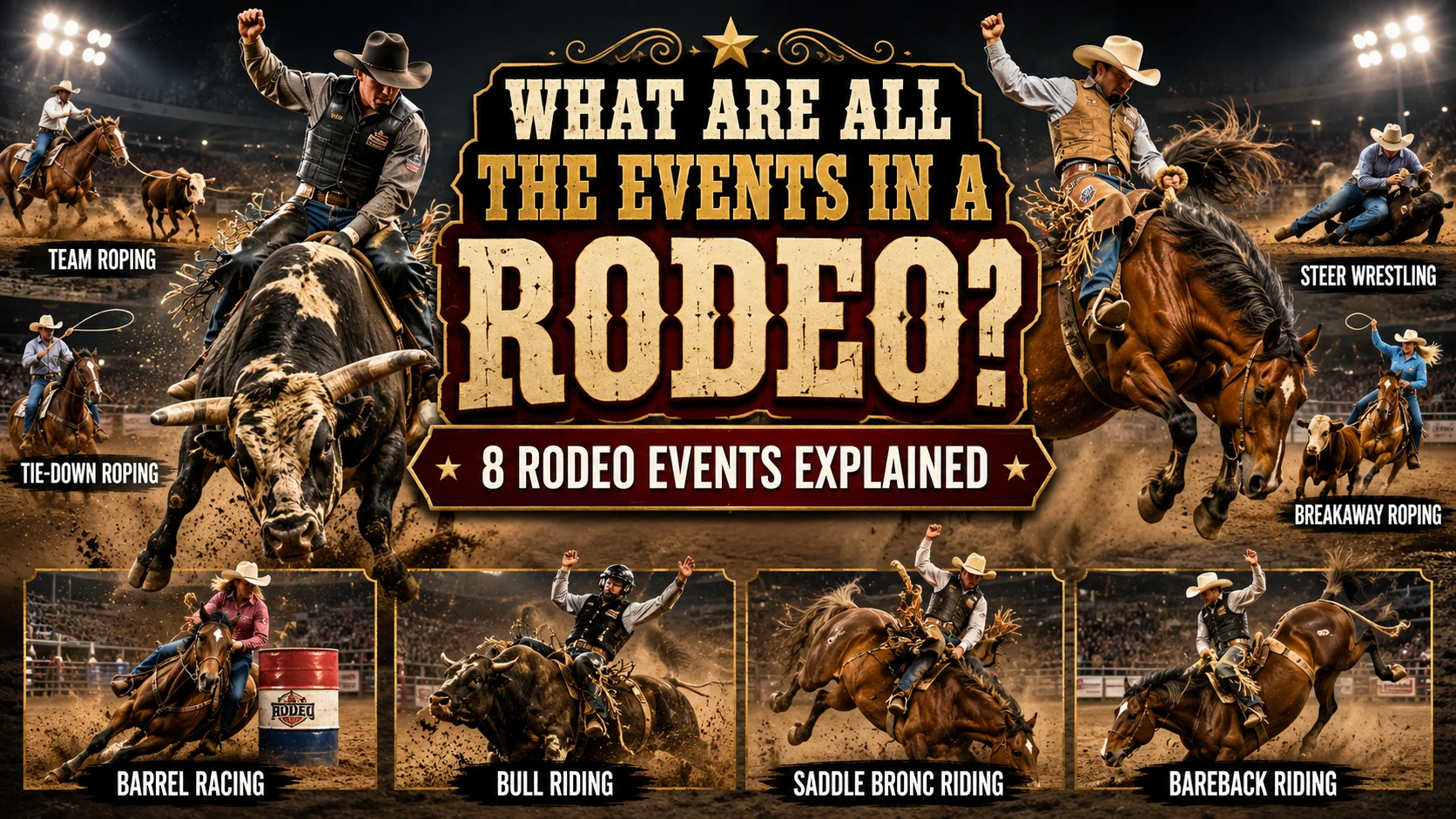

What Are All The Events In A Rodeo? The main pro rodeo events are bareback riding, steer wrestling, team roping, saddle bronc riding, tie-down roping, barrel racing, breakaway roping, and bull riding. These are the eight events that most fans see at many modern major rodeos.
A standard rodeo has seven basic events, sanctioned by the PRCA: bareback riding, steer wrestling, team roping, saddle bronc riding, tie-down roping, barrel racing, and bull riding. Many rodeos are now adding an eighth – breakaway roping – the fastest-growing women’s event.
These are divided into roughstock events (riding a horse or bull, judged on a 100-point scale) and timed events (running and racing against the clock). The order begins with the explosive bareback riding and always ends with the bull riding, a crowd-favorite finale.
- 7 standard events at almost every PRCA rodeo; breakaway roping is the emerging 8th.
- Two types: roughstock (judged 0 – 100) and timed events (fastest time wins).
- The order is deliberate: bareback first to fire up the crowd, bull riding last for the finale
- More than 600 PRCA-sanctioned rodeos run each year across 44 states and Canada.
Table of Contents
The Two Types: Roughstock vs. Timed Events
Before the list, one thought unlocks everything: Every rodeo event is either roughstock or timed, and the only difference is how you win.
| Type | How you win | Events |
|---|---|---|
| ROUGHSTOCK | Judged on quality – ride a bucking animal 8 seconds, scored 0 – 100 | Bareback riding, saddle bronc riding, bull riding |
| TIMED | A race against the clock – fastest time wins | Steer wrestling, team roping, tie-down roping, breakaway roping, barrel racing |
What Events Take Place at a Rodeo? (The Full List)
Here is every event you’ll see at a professional (pro) rodeo – the answer to whether you’re asking what events take place at a rodeo, what are pro rodeo events, or simply what’s on the card tonight.
| Event | Type | Goal | Typical result |
|---|---|---|---|
| Bareback riding | ROUGH | Ride a bucking horse 8 sec with only a rigging handle | Score 0 – 100 |
| Steer wrestling | TIMED | Leap from a horse and wrestle a steer to the ground | 3.5 – 5 sec |
| Team roping | TIMED | Two ropers catch a steer’s horns and hind legs | 4 – 6 sec |
| Saddle bronc riding | ROUGH | Ride a bucking horse for 8 sec with a rein and saddle | Score 0 – 100 |
| Tie-down roping | TIMED | Rope a calf, dismount, and tie three legs | 7 sec |
| Breakaway roping | TIMED | Rope a calf; the rope breaks away from the saddle | 2 – 3 sec |
| Barrel racing | TIMED | Race a cloverleaf pattern around three barrels | 14 – 17 sec |
| Bull riding | ROUGH | Ride a bucking bull 8 sec, one hand only | Score 0 – 100 |
The 8 Rodeo Events in Order
Rodeos follow a deliberate sequence – the rodeo order of events – designed to balance danger with speed. The seven standard events are run in a fixed order, with roping usually interspersed as a modern eighth in timed events. Large continuous rodeos such as the NFR have the same sequence all ten nights. Smaller rodeos may vary this, but bull riding is virtually always the same.
The standard rodeo order of events
ROUGHSTOCK TIMED — events alternate to keep the pace
Why this order? The bareback ride opens because it’s the most explosive event, instantly gripping the crowd. The roughstock and timed events then alternate, which keeps the pace varied and gives the arena crew time to rearrange the chutes and cattle between disciplines. And the bull ride always closes the show – the sheer drama of a 150-pound rider versus a 1,500-pound bull makes it an undisputed crowd favorite.
Every Event Explained
1. Bareback riding (roughstock)
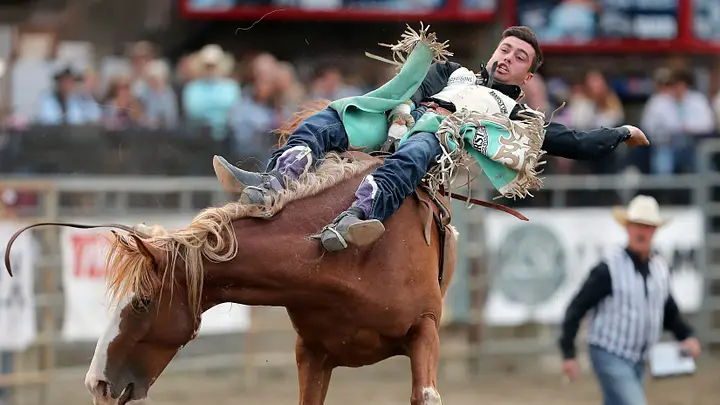
The rider holds onto a leather rig with the horse – no saddle, no reins – and must walk for 8 seconds. The mark-out rule requires both spurs to be above the horse’s shoulders as it leaves the saddle. Bareback riders endure more physical punishment and long-term wear than any other rodeo athlete.
2. Steer wrestling (timed)
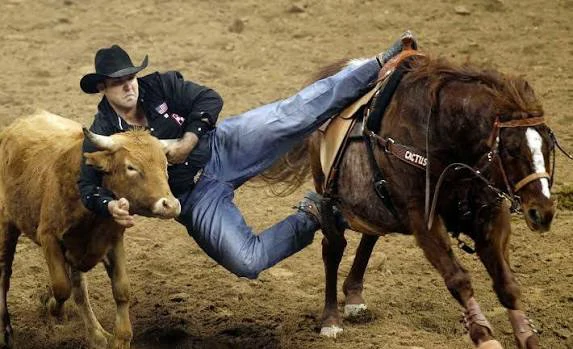
Also called bulldogging, the cowboy mounts a running steer from a galloping horse, grabs its horns, and wrestles it to the ground. A second rider, called a heiser, keeps the steer upright and often earns a share of the winnings. Winning times are often less than four seconds.
3. Team roping (timed)
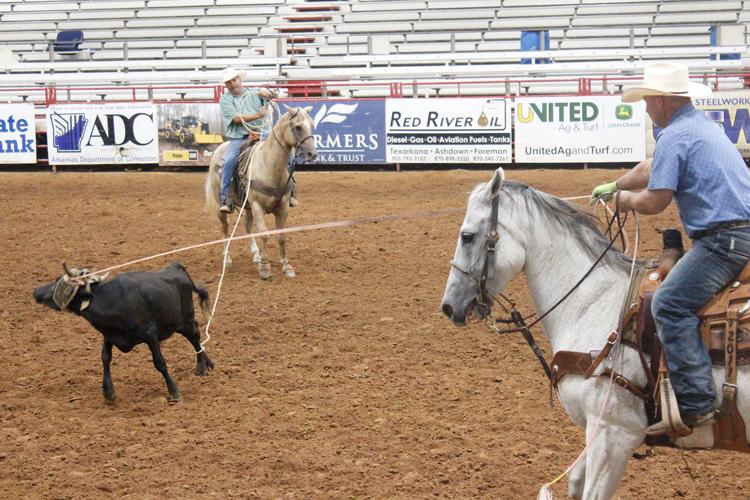
The only true team event. The header ropes the steer’s horns and turns it. The heeler ropes the hind legs. Timing is everything – a five-second penalty for a missed loop or a single hind leg can end the run.
4. Saddle bronc riding (roughstock)
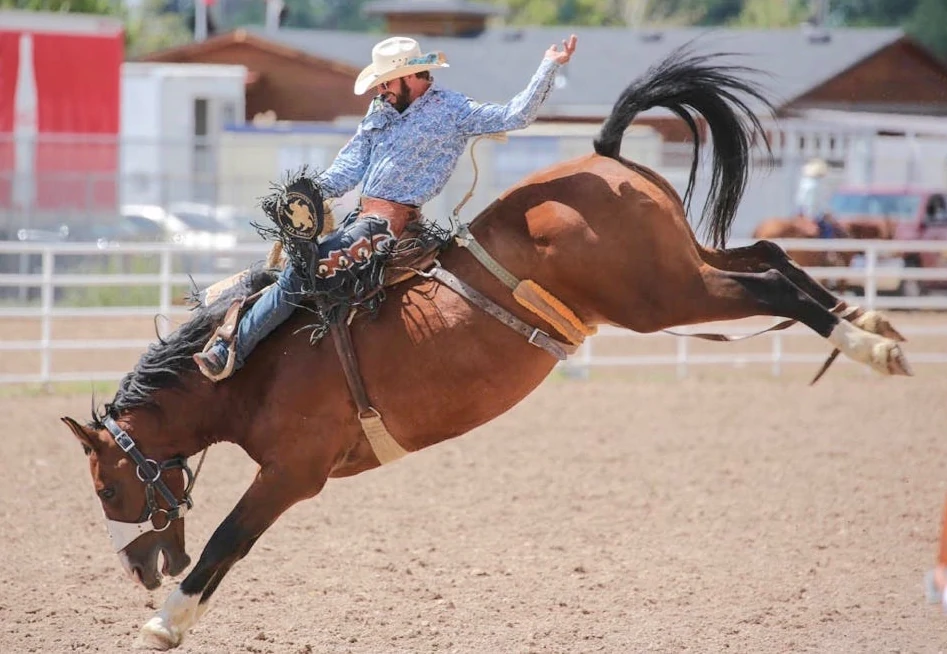
Rodeo’s oldest and most classic event, born from breaking wild horses. Using a specialized saddle and a thick rein, the rider matches the horse’s hiccup with a fluid, rhythmic, fast-paced movement for 8 seconds. Strength alone won’t score.
5. Tie-down roping (timed)
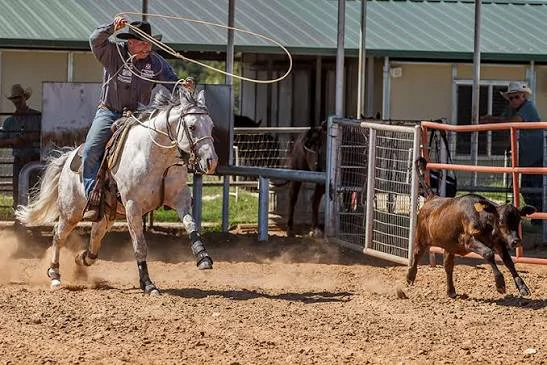
The cowboy ropes a calf, dismounts while the horse keeps the rope taut, then flanks the calf and ties any three legs. The horse’s training is half the battle. Winning runs last around seven seconds.
6. Breakaway roping (timed)
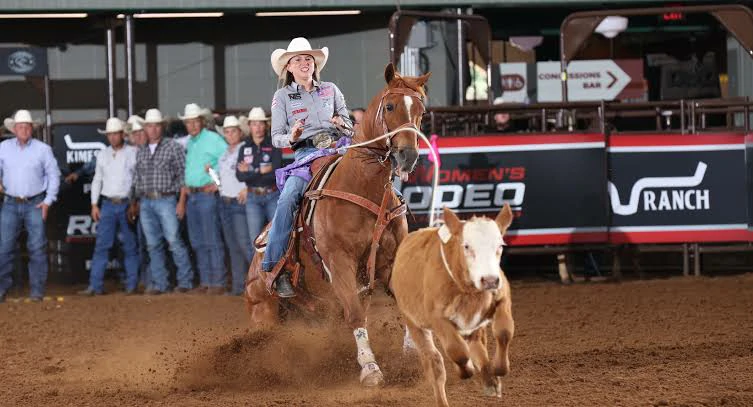
The fastest-growing event in rodeo is a showcase for women. The rope is tied to the saddle horn with a string that snaps when the calf’s head hits it. The clock stops on the break, and the elite runs are over in about two seconds.
7. Barrel racing (timed)
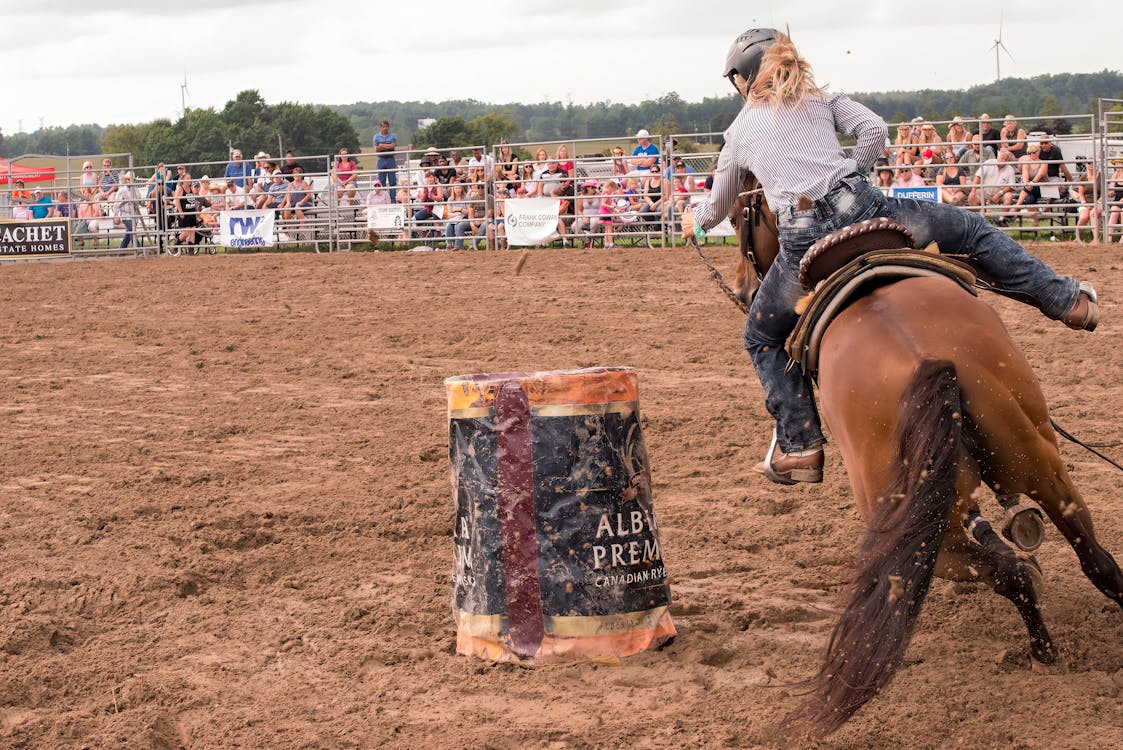
Primarily a women’s event run by the WPRA, a flat-out sprint around three barrels in a cloverleaf pattern. Knock a barrel over, and you add five seconds. Winning times are separated by hundredths of a second.
8. Bull riding (roughstock)
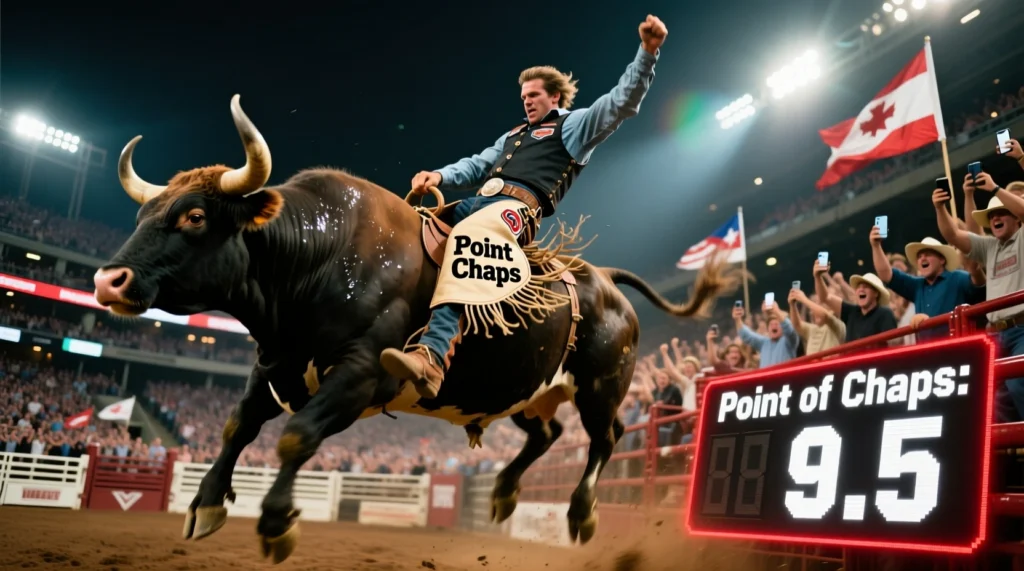
The final and most dangerous event. One hand on a flat braided rope, 8 seconds, on a 1,500-plus pound bull. Bullfighters move immediately at the end of the ride to protect the rider. Scores of zero are common.
How Rodeo Scoring Works?
Roughstock (0 – 100 points). Two judges each award up to 25 points for the rider and up to 25 points for the animal, for a combined maximum of 100. Half the score depends on the animal – a rider on an easy horse can’t score as high as one on a rank bucker. The rider must reach 8 seconds to earn any score, and touching the animal or himself with the free hand is an automatic disqualification.
Timed events (fastest time wins). The clock is everything, but so is the barrier – in roping and steer wrestling, the cowboy must give the animal a head start; leaving too early (breaking the barrier) adds a ten-second penalty. Downed barrels, illegal catches, and missed ties carry their own penalties, all defined under the official PRCA Rodeo 101 rules.
A Short History of Rodeo Events
Every rodeo event goes back to the real thing. Rodeo grew out of the everyday skills of 19th-century ranch hands and the traditions of Spanish vaqueros – roping calves for branding, breaking wild horses, and moving cattle. As ranch hands competed to prove who was the best, informal competitions evolved into organized rodeos. The Payson Pro Rodeo in Arizona bills itself as the world’s oldest continuously running rodeo, dating back to 1884, and Cheyenne Frontier Days – the “Daddy of ‘em All” – has been running since 1897.
Rodeo by the Numbers
Timed events – typical winning times
How long a champion-level run takes. Scale: 0 → 17 seconds
| Metric | Figure |
|---|---|
| PRCA-sanctioned rodeos each year | More than 600, across 44 states and Canada |
| Core events at a standard rodeo | 7 (plus breakaway roping as the growing 8th) |
| Qualified roughstock ride | 8 seconds, scored on a 100-point scale |
| Rodeos a top pro enters per year | Often 100+ (some fewer than 30) |
| The championship | Wrangler NFR – top 15 per event, 10 nights each December |
The Greatest of Each Event
| Metric | A legend of the event |
|---|---|
| All-around (all events) | Trevor Brazile – a record 26 world titles |
| Bull riding | Don Gay (8 PRCA titles); J.B. Mauney and José Vitor Leme in the PBR era |
| Saddle bronc | The Wright family of Utah – a modern dynasty |
| Steer roping | Guy Allen – 18 world titles, the most in any single event |
| Barrel racing | Charmayne James – 11 world championships |
Want to go deeper on the champions? See our guides to the greatest rodeo cowboy of all time and the richest rodeo cowboy.
Latest: 2025 – 2026 Major Rodeos
The rodeo calendar runs year-round and peaks in the summer. Marquee stops for the current season include:
2025–2026 major rodeo calendar
The marquee stops of the season, in order
- MarchRodeoHouston (Houston, TX) – the world’s largest indoor rodeo by attendance, 2.7M+ visitors over about 20 days.
- Jun 19–28, 2026Reno Rodeo (Reno, NV) – the “Wildest, Richest Rodeo in the West.”
- Jul 3–12, 2026Calgary Stampede (Calgary, AB) – “The Greatest Outdoor Show on Earth,” over a million visitors.
- Jul 17–26, 2026Cheyenne Frontier Days (Cheyenne, WY) – the “Daddy of ’em All”; 130th year, 10 straight days, purse rising to $960,000.
- AugustOmak Stampede (Omak, WA) – four days of PRCA rodeo plus the world-famous Suicide Race.
- Early DecemberWrangler NFR (Las Vegas, NV) – the sport’s championship, where world titles are decided.
The Future of Rodeo Events
Rodeo is evolving without losing its roots. The explosive growth of breakaway roping is giving women a one-time event with their own championship. Team-based and tour formats (led by the PBR and the new PRCA playoff structure) are bringing rodeo to arena cities year-round. And expanded prize money – like Cheyenne’s Leap to nearly a million dollars – is raising the stakes. The eight events themselves are timeless, but how and where fans experience them continues to expand.
Case Study
The Omak Stampede is useful because it shows how a rodeo can be more than just a competition on the field. A larger community rodeo may include PRCA rodeo performances, parade traditions, carnivals, children’s events, local cultural events, vendor parades, rodeo dances, specialty races, and local traditions.
This helps readers understand that “all rodeo events” can mean two things: the official rodeo competition events and the entire weekend event experience surrounding the rodeo.
Expert Insight: What New Fans Should Watch First
If this is your first rodeo, watch for three things:
- The clock in timed events.
- The eight-second ride in roughstock events.
- The horse or bull’s performance is not only the cowboy’s.
Rodeo is not just about the rider. The animals are athletes too. A great bronc or bull can make a ride harder and increase the score if the cowboy covers the ride.
Frequently Asked Questions: What Are All The Events In A Rodeo?
What are the 8 rodeo events in order?
In standard order: bareback riding, steer wrestling, team roping, saddle bronc riding, tie-down roping, breakaway roping, barrel racing, and bull riding. Bareback opens the show, and bull riding always closes it.
What events take place at a rodeo?
Both roughstock events (bareback, saddle bronc, bull riding) and timed events (steer wrestling, team roping, tie-down, breakaway, barrel racing). Some rodeos also feature fun extras like mutton bustin’ for kids.
What are pro rodeo events?
Pro Rodeo refers to the elite level of rodeo competitions, where proficient athletes compete in events such as bareback riding, steer wrestling, team roping, saddle bronc riding, tie-down roping, breakaway roping, barrel racing, and bull riding. These events are governed by organizations like the Professional Rodeo Cowboys Association (PRCA) and the Women’s Professional Rodeo Association (WPRA).
Pro Rodeo is a well-liked sport in North America, combining aspects of traditional ranching with modern entertainment.
Competitors travel to various rodeos throughout the year, accumulating points and prize money, often leading to distinguished events like the National Finals Rodeo (NFR).
The same seven-to-eight events are judged under professional rules at more than 600 sanctioned rodeos each year.
Why is bull riding always last?
Because it’s the most dramatic and dangerous event. Saving it for the finale sends the crowd home on the greatest possible high.
What’s the difference between roughstock and timed events?
Roughstock events are judged on a 100-point scale, with the rider required to stay within 8 seconds. Timed events are won by the fastest time.
What is the difference between Pro Rodeo and Rodeo Clown?
A professional rodeo competitor, often referred to as a cowboy or cowgirl, is an athlete who participates in timed or scoring events, including bull riding, calf roping, and barrel racing.
A rodeo clown, also known as a bullfighter, is a specialized entertainment and safety expert responsible for removing the bull and ensuring the safety of riders following a fall.
Bottom Line
All rodeo events can be grouped into roughstock events and timed events. The eight major modern rodeo events are bareback riding, steer wrestling, team roping, saddle bronc riding, tie-down roping, breakaway roping, barrel racing, and bull riding.
Traditional PRCA-style rodeos often focus on seven basic events, while modern major rodeos may include breaking as an eighth. Some rodeos also include steer roping, mutton busting, ranch bronc riding, junior events, special events, and local traditions.
A rodeo is a complete Western sporting event that includes riding, roping, racing, wrestling, cattle, athletes, and the tradition of the field, with each event testing skills originating from a different farm.
Sources
- PRCA – Rodeo 101 (official event rules & structure)
- Professional Rodeo Cowboys Association – events, WPRA women’s events & season structure
- Cheyenne Frontier Days – 2026 dates, format & purse
- Calgary Stampede – 2026 rodeo (July 3 – 12)
- Sports Planning Guide – biggest rodeos & attendance figures
- Justin Boots – Rodeo 101 PRCA rodeo count & season overview
Event descriptions follow official PRCA and WPRA rules; winning-time ranges are typical figures that vary by rodeo and conditions. Confirm dates on each event’s official site